Non-conformities that close and audits without weeks of paperwork
A QMS manages control points, inspections, non-conformities, corrective actions and documents. We analyse your quality system and help you choose the tool for your standard.
35 questions: nonconformities and complaints, corrective actions (CAPA) and 4 more topics

Controls, findings and actions in one loop
A quality management system (QMS) records receiving and in-process inspections, opens non-conformities, assigns corrective actions and verifies their closure.
It also controls which version of each procedure is current, the first thing an auditor checks.
Processes it covers
- Receiving inspection
- In-process control
- Non-conformities
- Corrective and preventive actions
- Document control
- Audits

Companies that need a QMS, and cases where another option fits better
Who it is for
- Companies certified or working towards ISO 9001, or audited by customers and for GMP
- Quality managers who track nonconformities, corrective actions and documents in spreadsheets and folders
- Food, packaging, pharma or metalworking plants with recurring customer complaints
When it is not the right fit
- If you only need receiving and in-process checks tied to orders, Odoo Quality may be enough without a separate QMS
- If the laboratory is at the heart of the problem, the right system is a LIMS
Signs it is time to assess a QMS
- Non-conformities are recorded but corrective actions never close
- Preparing an ISO audit takes weeks of gathering paper
- Customer complaints are not linked to the lot or order that caused them
- Quality certificates are built by hand for each shipment
- Rework shows up in inventory instead of at the control point
- Current procedures coexist with old versions
The cost of quality on paper
Repeated rework
Without a recorded cause, the same defect returns and is reworked again.
Rejected product that ships
If the quality result does not block the lot, it can ship before anyone warns.
Costly audits
Weeks of hunting for records before each audit tie up the people who should be improving quality.
From the nonconformity to the action that stops it recurring
Online assessment
35 questions on quality management. When you finish you see your level by dimension.
30-minute review
Diego reviews with you how many nonconformities remain open, how long they take to close and how an audit is prepared today.
Quality workshop
With quality and production we review the control plan, the non-conformity cycle and document control against your standard.
Selection and integration
We compare 2 to 4 options, from Odoo Quality to specialist platforms, and define how a result blocks the lot in inventory.

Data, master records and access your company provides for a QMS
- Master document list with version and owner
- Nonconformity, complaint and corrective action log for recent months
- Control or inspection plans per product
- Reports from the latest internal and external audit
- List of evaluated suppliers and their criteria
Deliverables of the QMS analysis, selection and integration
Nonconformity-to-CAPA flow
States, owners and deadlines from logging to effectiveness check, with root-cause analysis (5 whys, 8D).
Flow approved by quality
Document control
Draft, review, approval and distribution cycle, with the current version at the workstation.
Document procedure
Platform selection
Odoo Quality and specialised QMS compared on the modules you need: audits, suppliers, calibration, complaints.
Decision matrix
Link with operations
Blocked lots, receiving inspections and complaints coming from the ERP, and holds the QMS sends back.
Integration map
Typical risks of a QMS project and how they are controlled
Digitising the paper as it is
ControlThe flow is simplified first and the form follows the flow, not the other way round.
CAPAs that never close
ControlA deadline per state and an overdue dashboard reviewed at the quality committee.
A system used only for the audit
ControlPlant records are born in the system during daily operations.
Scope limits and market options for QMS
Limits
- We do not implement the chosen QMS; the vendor or its integrator does
- The system does not certify: the audit body grants certification
- If the decision is Odoo Quality inside an Odoo we implement, it joins that project
Selection criteria
- Your standard’s requirements: ISO 9001, GMP, HACCP or another
- Full non-conformity and corrective action cycle
- Document control with approval and versions
- Integration with inventory, production and the laboratory
Odoo
Odoo Quality: control points, alerts and checks at receiving and in manufacturing. We assess it as one more option, with the same criteria as the rest.
Other platforms on the market
- ETQ Reliance
- MasterControl
- Intelex
- Veeva Vault QualityDocs
- Qualio
- SAP QM
In no order of preference.
Complaints, credit notes and health authorities
- Complaints Book under the Consumer Protection Code, with a response deadline, for companies selling to end consumers
- Returns from complaints linked to their electronic credit note filed with SUNAT
- GMP and HACCP records required by DIGESA for food and DIGEMID for pharmaceuticals
Systems that exchange data with a QMS
Material requirements planning
control points per operation
See the systemMESManufacturing execution system
in-process inspections
See the systemLIMSLaboratory information management system
laboratory results per lot
See the systemDMS/ECMDocument and enterprise content management
controlled procedures and records
See the systemERPEnterprise resource planning
lot blocking and release
See the systemPLMProduct lifecycle management
specifications per product version
See the systemEHS/SSTEnvironment, health and safety
shared findings and actions
See the systemQMS assessment in 9 minutes
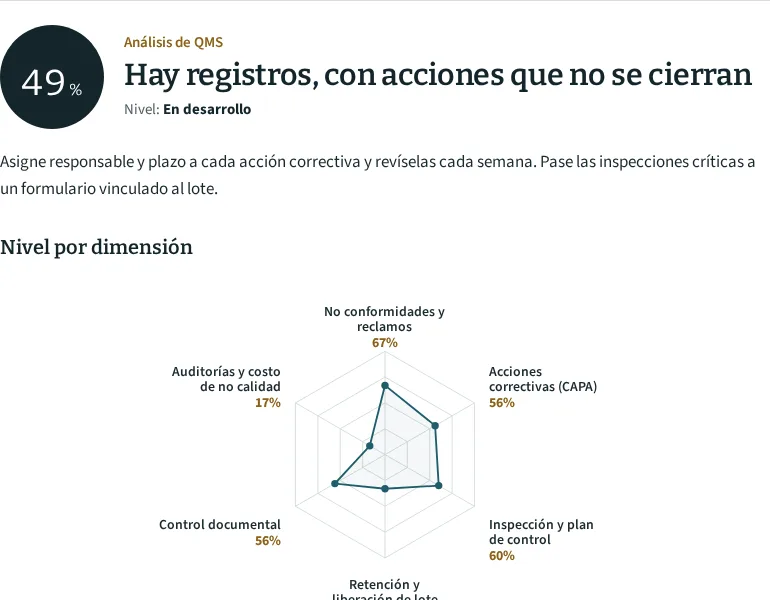
This assessment measures how your plant controls quality from receiving to shipping. The questions cover nonconformities, corrective actions, control plan, batch holds, documents and audits.
Scored dimensions
- Nonconformities and complaints by batch. Whether each internal nonconformity or customer complaint is recorded, classified and linked to the batch and production order that caused it.
- Root cause and corrective action. Whether repeated failures get root cause analysis, an action with owner and date, and verification that they did not recur.
- Control plan and inspection. Whether each product has control points with specification and tolerance, inspections recorded on the spot and calibrated measuring equipment.
- Batch hold and release. What prevents shipping a held batch, who can release it and how the signature and the certificate that goes with the shipment are recorded.
- Current document control. Whether each procedure and specification has one approved current version, earlier ones withdrawn and proof that affected staff read it.
- Audits, suppliers and cost of poor quality. Whether the internal audit program is met, suppliers are rated on actual rejections and the cost of rework and rejections by cause is known.
What you receive
At the end you receive your level in each quality system dimension. Each gap comes with a first action quality can check at the plant.
19 scored questions and 11 context questions (type of operation, size, current system). Context questions are not scored: they let us read the result against similar operations.
35 questions, 9 minutes
Example: if corrective actions are not verified after closure, the result flags Corrective actions (CAPA) and proposes follow-up with evidence.
Answers about QMS
Certification is granted by an accredited body. The QMS organises records and evidence so the audit finds what the standard requires.
If checks cover receiving and production, the ERP quality module may be enough; demanding sector standards often call for a specialist platform. The assessment shows which.
A specialised QMS is implemented by its vendor. We design the nonconformity-to-CAPA flow and document control, run the selection and review the configuration against those flows.
Review your QMS result with Diego
Twenty minutes by video call or WhatsApp. Have at hand the nonconformity log for the last quarter.
Assessment first: the review uses your answers.