AI assistants that answer, log and hand over to a person when needed
I pick a measurable use case, organise the information AI needs and connect the assistant to your CRM, help desk or ERP, with narrow permissions and a data policy.

35questions on use cases, sources and personal data, in 8 minutes
Language models connected to your data and processes
An AI assistant uses a language model to answer queries, classify requests or read documents. An agent also acts in your systems: it looks up an order, creates a ticket, books an appointment.
The model writes well, but it does not know your prices or policies. It answers only as well as the information it connects to, and it needs a way out to a person.

Signs your company needs one
- The team answers the same questions every day
- Requests arrive on WhatsApp and are not logged
- Invoices, orders or complaints are read to copy data
- Internal information is scattered and hard to find
- An AI tool was tried without connecting it to the data
- It is unclear which data may be sent to an external model
AI and agents: who it is for and when it does not fit
A good fit for
- Companies that receive repeated enquiries via WhatsApp or web and log them by hand
- Teams that extract data from invoices, delivery notes or scanned forms
- Teams that search for answers in manuals, policies or past tickets

Not a fit when
- There is no measurable case: the aim is to «use AI» without knowing which task improves
- The answer requires a decision with legal or medical consequences without human review
- The knowledge the assistant must use is not written down anywhere
The cost of staying as you are

Hours on repeated answers
Answering hours, prices and order status ties up the team that could handle cases needing judgement.
Unlogged requests
What only lives on one person’s phone cannot be tracked, measured or picked up if that person is away.
Data at risk
Without a policy, customer data ends up pasted into external tools without control.
How I assess AI and agents in four steps
I choose a case with a current measure and a human hand-off. The assistant is built on bounded sources and reviewed against real conversations.
I pick a measurable case
Volume, channel, metric and baseline for the task to solve.
I organise the knowledge
Written answers, data sources and a set of real questions for testing.
I build and connect
An assistant that logs to the CRM or help desk, with narrow permissions and human hand-off.
I measure and review
Resolution without intervention, escalations and a weekly sample of answers.
What your company provides for the artificial intelligence and agents project
A case with its current measure
How many enquiries or documents arrive and how long they take to handle today.
Knowledge sources
Current manuals, price lists, policies and FAQs, with someone responsible for keeping them up to date.
Personal data policy
Which customer data the assistant may read and what it must not, under Peru’s Law 29733.
A human hand-off
Who takes over when the assistant does not know or the customer asks for a person.
From assessment to implementation
Use case and policy
Choice of the first case, metric, baseline and AI data policy.
Assistants and agents
WhatsApp or web service, request classification and document data extraction.
Connection and measurement
Integration with CRM, help desk or ERP, and a resolution and quality dashboard.

Diego Muñoz
I implement AI assistants and agents connected to your systems: WhatsApp or web service that logs every request in the CRM or help desk, document data extraction and internal knowledge search, with human hand-off, narrow permissions and measurement.
I implement this type of system
Take the assessmentMarket options
Model providers differ in usage cost, where they process data and how well they follow instructions in Spanish.
Odoo AI
Recent Odoo versions include AI features, such as assisted writing and a website chatbot, and connect to external models. They are useful when conversations and data already live in Odoo.
Other platforms I assess
- OpenAI
- Anthropic Claude
- Google Gemini
- Microsoft Copilot Studio
- Amazon Bedrock

Selection criteria
- Use case and volume that justify usage cost
- Where data is processed and stored
- Connection to your channels and systems
- Quality measured with your own questions
- Human hand-off and narrow permissions
AI and agents: limits and alternatives
Model errors
A language model can answer wrongly. That is why each assistant has bounded sources, a conversation log and a hand-off to a person.
Usage cost
The model provider charges by volume. Cost is estimated with the case’s real volume before building.
WhatsApp and its rules
The WhatsApp Business API has approved templates and reply windows that limit what the assistant can send.

Which other systems it connects to
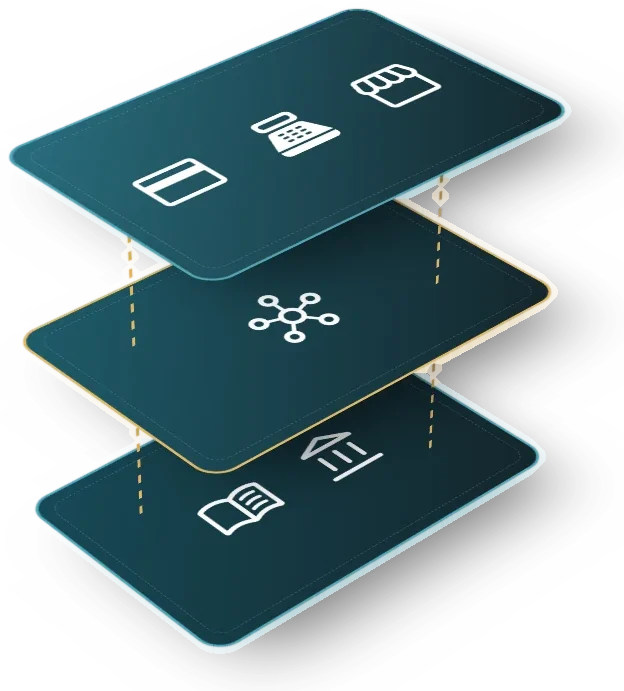
Customer relationship management
Every conversation is logged on the customer record.
See the systemHelp desk and customer support
The assistant creates the ticket and hands over the case with its history.
See the systemOmnichannel contact center
Automated and human service on the same channels.
See the systemEnterprise resource planning
Order, stock and invoice lookups with read-only permissions.
See the systemDocument and enterprise content management
Search over internal documents with references to the source.
See the systemRobotic process automation
AI reads the document and the bot loads the result.
See the system35 questions and 8 minutes to see where to start
This assessment measures whether your company is ready to use AI assistants and agents connected to its systems. The questions describe observable facts, such as where WhatsApp orders end up or who answers for what the assistant says.
Scored dimensions
- Use case and handoff. It looks at whether the first AI use has a scope, an indicator and an owner, and what happens when the assistant must hand the conversation to a person.
- Answer base and data sources. It looks at whether frequent answers are written and current, and whether the data the assistant needs comes from an official source with an owner.
- Answer testing and measurement. It looks at whether answers are tested before going live, whether a sample is reviewed in real use and whether resolved inquiries are measured.
- Logging and actions in systems. It looks at whether what arrives by WhatsApp or email is logged in the ERP, the CRM or the help desk, and what an assistant can look up or record in them.
- Owners and team usage. It looks at who approves the assistant's content, how the team uses AI in its work and whether tools are approved.
- Data, permissions and manipulation. It looks at which data may go to an external model, with what permissions an assistant acts in your systems and how it is protected from hidden instructions.
What you receive
When you finish, you receive your level in six applied AI dimensions and the gaps ranked by priority. Each one comes with the first concrete action to close it.
17 scored questions and 13 context questions (type of operation, size, current system). Context questions are not scored: they let us read the result against similar operations.
Free of charge. Only Diego Muñoz sees your answers.

Before you start
Whichever best solves your case with your data and policy: OpenAI, Anthropic Claude, Google Gemini or another. The choice comes from a set of real questions, not from the brand.
Yes, through the official WhatsApp Business API, which has its own rules for templates and conversation windows. What I do not recommend is automating a personal number.
It is defined in a policy before starting: which data is sent to the model, with which provider and under which terms of use. Peru’s Personal Data Protection Law applies here too.
The online assessment and the 30-minute review with Diego are free and carry no commitment.
Only Diego Muñoz sees them, to prepare the review. They are not shared with third parties or used for bulk mailings.
Review your AI and agents case with Diego in 30 minutes
Diego Muñoz replies in person, on Lima time. If you have taken the assessment, he comes with your answers already read.
WhatsApp +51 919 488 260 · damunoz@dmunozgroup.com