What happens on every shift, recorded as it happens
An MES records orders, downtime, consumption, scrap and operators on the shop floor. We measure how your plant records today and help you choose and integrate the platform.
36 questions: orders and instructions, downtime and OEE and 4 more topics

Shop-floor recording between the plan and the machine
A manufacturing execution system (MES) records on the shop floor when each order starts, downtime, consumption, output, scrap and the operators involved.
With that data the supervisor sees progress against plan during the shift and the company calculates OEE.
Processes it covers
- Order execution
- Downtime recording
- Short-interval control
- Lot traceability
- Scrap recording

Companies that need an MES, and cases where another option fits better
Who it is for
- Continuous or batch plants that record the shift on paper and key it in the next day
- Production and continuous-improvement managers who need OEE per machine and the cause of each stop
- Industries with traceability required by customers or regulators: food, pharma, packaging, auto parts
When it is not the right fit
- If the plant has one or two machines and paper records arrive on time, the ERP shop floor view is enough
- If there are no manufacturing orders in a system: the MES executes orders and needs to receive them from the ERP
Signs it is time to assess an MES
- Machine stoppages are written on paper or not at all
- OEE is unknown or calculated once a month from doubtful data
- Shift output is keyed in the next day
- Nobody knows which operator or lot was involved in a product under complaint
- Scrap is discovered in the inventory count instead of on the line
- Supervisors cannot see progress against plan during the shift
The cost of learning about the shift the next day
Invisible stoppages
Short stoppages are not written down and explain the gap between planned and actual output.
Scrap found too late
Scrap shows up in the month-end count, when nobody knows which order or shift caused it.
Complaints without traceability
After a complaint, rebuilding operator, machine and lot takes days of searching through paper.
From downtime noted on paper to OEE per shift
Online assessment
36 questions on shop-floor production recording. When you finish you see your level by dimension.
30-minute review
Diego reviews with you how a stop is recorded today, who codes it and which formula your plant uses for OEE.
Shop-floor workshop
We follow one order end to end with supervisors and operators, code downtime reasons and agree the OEE definition.
Selection and integration
We compare 2 to 4 options, from the Odoo shop-floor view to industrial MES platforms, with a one-line pilot and three-year total cost.

Data, master records and access your company provides for an MES
- List of machines and lines with their rated speed
- Stop and reject causes each area uses today, even on paper
- Shift reports from recent weeks
- Manufacturing orders and bills of materials from the ERP
- Plant network layout and connection points available for terminals
Deliverables of the MES analysis, selection and integration
OEE definition
Availability, performance and quality formula agreed by the plant, with which stops count and which do not.
Indicator sheet
Stop and reject catalogue
Coded causes per machine, short and selectable on a touch screen without typing.
Catalogue approved by production
Shop-floor terminals
Location, device type and screens the operator sees at each station, and what is read automatically from the machine.
Terminal layout
ERP and MES integration
Orders flowing from ERP to MES and output, consumption, scrap and lots flowing back, with a single point of entry.
Interface specification
Typical risks of a MES project and how they are controlled
OEE with a different formula per shift
ControlThe indicator sheet is signed off before any screen is configured.
Operators going back to paper
ControlScreens with few taps tested with operators from every shift during the pilot.
Output recorded twice
ControlOne point of entry per data item; the ERP receives from the MES and nothing is keyed in parallel.
Scope limits and market options for MES
Limits
- We do not install terminals or configure the MES; the vendor or its integrator does
- Automatic reading from older machines may need sensors or an extra PLC, quoted by the automation vendor
- A validated electronic batch record for pharma also requires the vendor’s computer system validation
Selection criteria
- Simple recording for operators, on a terminal or tablet
- Reading machine data where possible
- Lot, operator and machine traceability
- Integration with your ERP for output and consumption
Odoo
Odoo Manufacturing with the Shop Floor view and Odoo IoT. We assess it as one more option, with the same criteria as the rest.
Other platforms on the market
- Siemens Opcenter Execution
- Rockwell Plex / FactoryTalk ProductionCentre
- AVEVA MES
- Critical Manufacturing
- Tulip
In no order of preference.
Systems that exchange data with an MES
Material requirements planning
orders and bills of materials
See the systemSCADA/HMISupervisory control and data acquisition
machine counters and states
See the systemIIoTIndustrial IoT and data historian
data series with order context
See the systemQMSQuality management system
in-process checks and non-conformities
See the systemERPEnterprise resource planning
output, consumption and scrap
See the systemBI/DWBusiness intelligence and data warehouse
OEE and progress for dashboards
See the systemEAM/CMMSEnterprise asset management / maintenance management
stoppages that open maintenance orders
See the systemMES assessment in 9 minutes
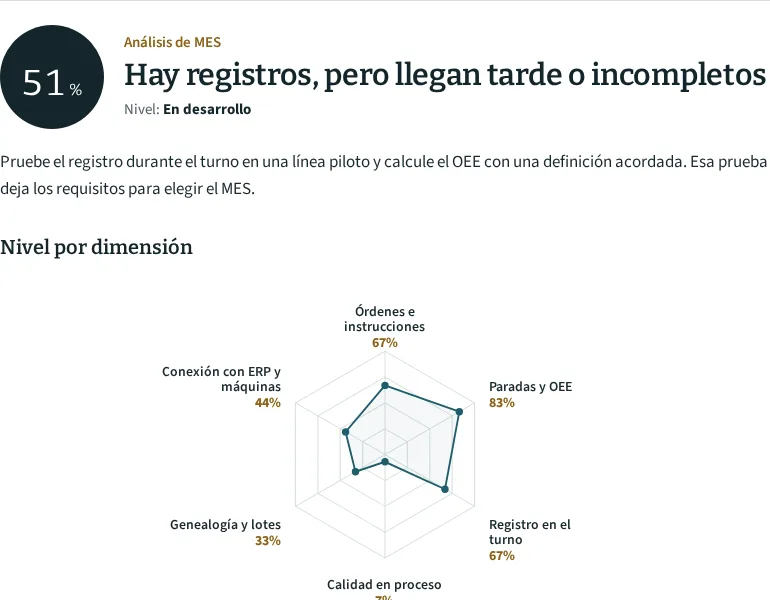
This assessment examines how your plant records production order execution, downtime, OEE, consumption, scrap, quality controls and batch genealogy. Questions review observable workstation practices, recording timeliness and connectivity among machines, MES and ERP.
Scored dimensions
- Orders and instructions. Checks how production orders, routings and work instructions are presented and updated at each workstation.
- Downtime and OEE. Evaluates downtime recording, reason codes and the data used to calculate OEE by machine, line and shift.
- In-shift production recording. Checks when and where produced quantities, operation times and operator activities are recorded.
- Quality and scrap. Reviews in-process inspections, rejected output, rework and release decisions associated with each operation.
- Production genealogy. Determines whether each finished batch can be linked to the material batches, equipment, operations and operators involved.
- MES and ERP integration. Examines how production quantities, material consumption, scrap and order statuses move between the shop floor and ERP, including during connection failures.
What you receive
Upon completion, you will receive a shop-floor recording maturity level and a breakdown of gaps in orders, downtime, in-shift capture, quality, traceability and integration. Results will include initial actions for requirements assessment and MES option evaluation, from the Odoo Manufacturing shop-floor interface to industrial platforms, based on identified constraints.
19 scored questions and 12 context questions (type of operation, size, current system). Context questions are not scored: they let us read the result against similar operations.
36 questions, 9 minutes
Example: if stoppages are described by hand and OEE is estimated at month end, the result flags Downtime and OEE and proposes a reason list agreed with the plant.
Answers about MES
The ERP plans and accounts; the MES records what happens at the machine during the shift. Together they close the order loop.
If machines provide no data, the operator records at a terminal. Machine connections are added where possible.
The MES vendor or its integrator installs terminals, configures screens and connects machines. We define OEE, the stop catalogue and the ERP interface, and review the plant pilot against those definitions.
Review your MES result with Diego
Twenty minutes by video call or WhatsApp. Have at hand a real shift report and the list of machines.
Assessment first: the review uses your answers.