The whole plant on one screen, with alarms that get answered
SCADA and HMI supervise equipment in real time from screens connected to PLCs and sensors. We analyse what your plant needs to supervise and what data management should receive.
35 questions: alarm management, tags and naming and 4 more topics
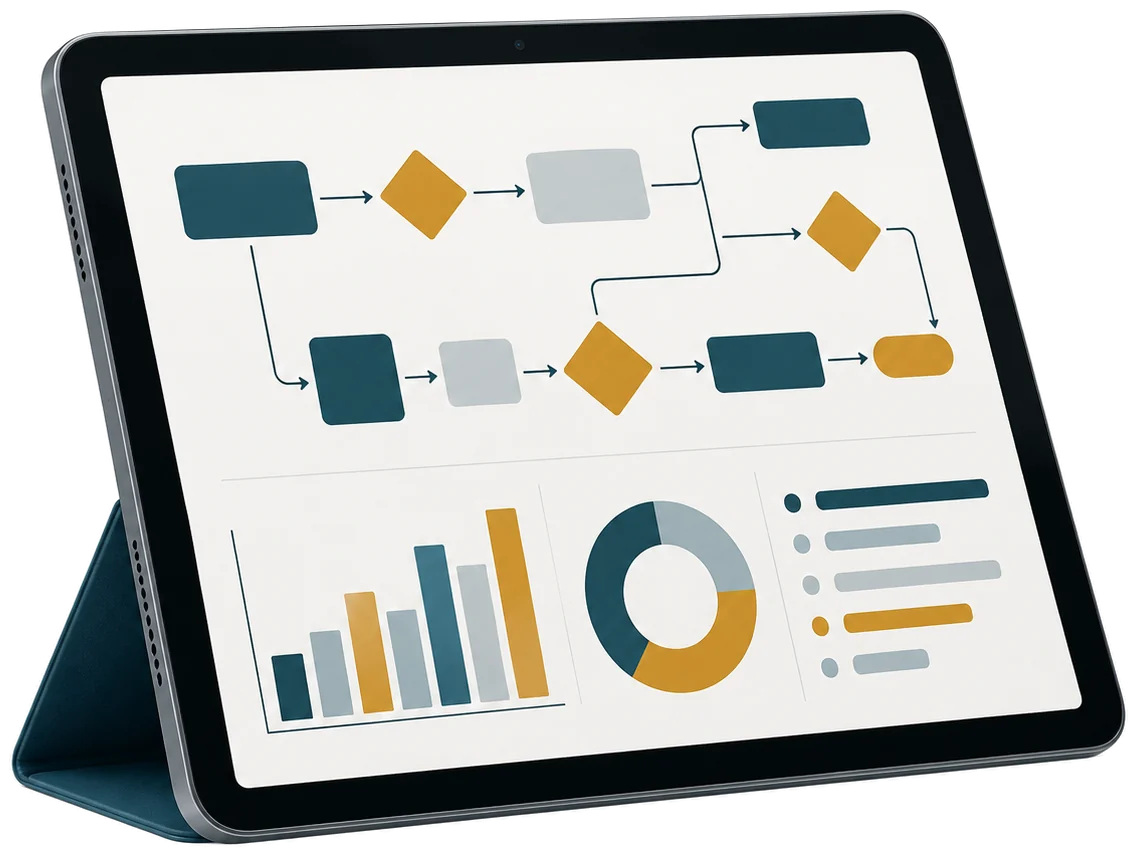
Real-time supervision and control
A supervisory control and data acquisition (SCADA) system gathers variables from PLCs and sensors, shows the process on operator screens (HMI) and manages alarms.
It is the layer closest to the machine. Its data feeds the historian, the MES and maintenance.
Processes it covers
- Process supervision
- Alarm management
- Loop control
- Tag logging

Companies that need a SCADA system, and cases where another option fits better
Who it is for
- Process plants with continuous variables: water and wastewater, energy, mining, food, chemicals
- Operations and maintenance managers who receive alarms nobody answers or that sound all shift
- Management who need process data in production, maintenance or the ERP without opening the control network
When it is not the right fit
- If the problem is PLC programming or process control: an automation integrator solves it
- If what is missing is data history for analysis, a historian on the current SCADA costs less than replacing it
Signs it is time to assess a SCADA system
- Process parameters are read at the machine and written by hand
- Alarms are not logged with time, cause and owner
- Several screens from different vendors do not talk to each other
- Management cannot see plant status outside the shift
- Machine data does not reach the ERP or the MES
- A PLC change depends on an outside vendor with no documentation
The cost of supervising by walking the plant
Failures detected late
An out-of-range variable is found when the operator passes the machine, sometimes hours after the problem started.
Alarms that keep coming back
Without time, cause or owner, alarms are not analysed and happen again.
Vendor dependence
A PLC change waits for the outside integrator, who holds the only programs and documentation.
From alarms nobody answers to an orderly control room
Online assessment
35 questions on plant equipment supervision. When you finish you see your level by dimension.
30-minute review
Diego reviews with you how many alarms an operator receives per shift, who handles them and which SCADA data the rest of the company needs today.
Plant inventory
With maintenance and operations we survey controllers, protocols, tags, critical alarms and how the control network is separated.
Selection and integration
We compare 2 to 4 platforms against your actual controllers and define which data flows to the historian, MES or ERP. Engineering is done by a specialist integrator.

Data, master records and access your company provides for a SCADA system
- Current architecture: PLCs, networks, servers and operator stations
- Tag and alarm list exported from the SCADA
- Alarm log for a few weeks
- Contact of the current automation integrator
- Remote access and IT network policy
Deliverables of the SCADA/HMI analysis, selection and integration
Alarm diagnosis
Alarms per shift, repeated and ownerless, with a proposal of priorities and expected responses.
Rationalised alarm list
OT network zones
Separation between the control and office networks, with the conduits through which data leaves to other systems.
Zones and conduits diagram
Requirements and platform matrix
Your PLC protocols, redundancy, per-tag licensing and local support compared across 2 to 4 platforms.
Signed recommendation
Data out to the business
Which variables go to the historian, MES or ERP, how often and over which protocol (OPC UA, MQTT).
OT-to-IT data map
Typical risks of a SCADA/HMI project and how they are controlled
Migrating alarms as they are
ControlRationalisation is done before the platform change, with operations and maintenance.
Remote access open to the internet
ControlAccess through a defined conduit, with named users and session logging.
Stopping the plant for the switch
ControlThe integrator tests in parallel and the switchover is planned during a scheduled shutdown.
Scope limits and market options for SCADA/HMI
Limits
- We do not program PLCs or configure HMI screens; an automation integrator does
- Odoo does not replace a SCADA: it receives summarised data from it for production and maintenance
- A formal industrial cybersecurity assessment is done by a certified specialist
Selection criteria
- Compatibility with your PLCs and protocols
- Licensing model by tags and clients
- Alarm management and event logging
- Network segmentation following IEC 62443
Other platforms on the market
- AVEVA (Wonderware) InTouch / System Platform
- Siemens WinCC
- Rockwell FactoryTalk View
- Ignition (Inductive Automation)
- Schneider EcoStruxure
In no order of preference.
Systems that exchange data with a SCADA system
Industrial IoT and data historian
process data series
See the systemMESManufacturing execution system
counters, states and stoppages
See the systemEAM/CMMSEnterprise asset management / maintenance management
running hours and equipment alarms
See the systemEHS/SSTEnvironment, health and safety
safety alarms and permits
See the systemSCADA/HMI assessment in 9 minutes
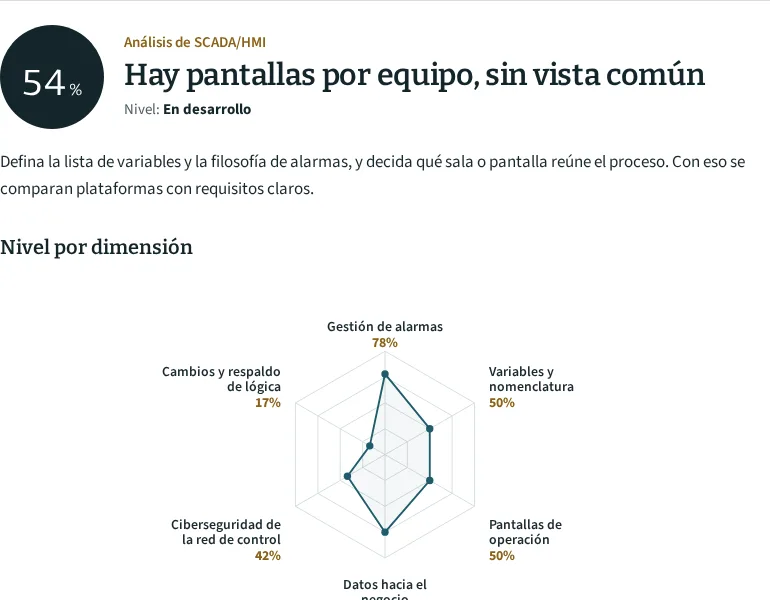
This assessment reviews how the plant and remote sites are supervised: alarms, tag naming, screens, control network and PLC backup. The questions describe situations observed in the control room and at shift change.
Scored dimensions
- Control room alarm management. It looks at whether each alarm has a priority, a written response and a record, and whether repeating or standing alarms are corrected.
- Tags and naming convention. It looks at whether each process variable has a single name with unit, range and equipment, used the same way in PLCs, screens, history and reports.
- Screens and process view. It looks at whether operators see process status from views by area and equipment, with a common convention and a warning when a value has lost communication.
- Process data to the business. It looks at whether data and alarms are stored with their timestamp and reach production, maintenance or the ERP without manual copying.
- Control network and remote access. It looks at whether the control network is separated from the office network, whether remote access is approved per session and whether each operator has an individual user.
- PLC changes and backup. It looks at whether each change to PLC logic or the SCADA project is approved, tested and leaves a backed-up version that matches what is installed.
What you receive
At the end you receive your level in each dimension and the gaps ranked by priority. Each gap comes with a first action your instrumentation and control team can verify.
19 scored questions and 11 context questions (type of operation, size, current system). Context questions are not scored: they let us read the result against similar operations.
35 questions, 9 minutes
Example: if alarms have no priority or written response, the result flags Alarm management and proposes cleaning up the most frequent ones first.
Answers about SCADA/HMI
The HMI is the operator screen of a machine or line; SCADA brings several HMIs, controllers and alarms into one supervision system.
Separating the control network from the office network and controlling remote access are baseline measures. The IEC 62443 series is the industry reference.
We do not do automation engineering or PLC programming. We analyse the need, help you choose and connect the data to management systems.
Review your SCADA/HMI result with Diego
Twenty minutes by video call or WhatsApp. Have at hand a screenshot of the main SCADA screen and one week’s alarm list.
Assessment first: the review uses your answers.