Fewer unplanned stoppages and the cost of every asset in view
A maintenance system plans preventive work, records corrective work and builds history and cost per asset. We analyse your maintenance and help you choose.
36 questions: preventive plan, asset register and criticality and 4 more topics

Planned maintenance, with history per asset
A computerised maintenance management system (CMMS) or enterprise asset management system (EAM) organises assets in a hierarchy, schedules preventive maintenance, issues work orders and records hours, parts and causes.
That history gives MTBF, MTTR and cost per asset, and supports repair-or-replace decisions.
Processes it covers
- Preventive maintenance
- Corrective maintenance
- Spare parts management
- Asset history
- Maintenance costing

Companies that need a maintenance system, and cases where another option fits better
Who it is for
- Plants, mines, fleets and service operations whose equipment stops production when it fails
- Maintenance managers who plan preventive work in spreadsheets and take requests by radio or WhatsApp
- Management who need maintenance cost per asset to decide whether to repair or replace
When it is not the right fit
- If you have few assets and maintenance is done by a contractor on its own system, tracking its orders in the ERP is enough
- If the list of assets with their location is missing, that inventory comes before any system
Signs it is time to assess a maintenance system
- Preventive maintenance lives in a calendar or on a whiteboard
- There is no failure history per asset
- Critical spares are missing when needed or pile up without turning
- Maintenance cost per asset is unknown
- Work orders go out on paper and do not come back complete
- Unplanned stoppages affect customer deliveries
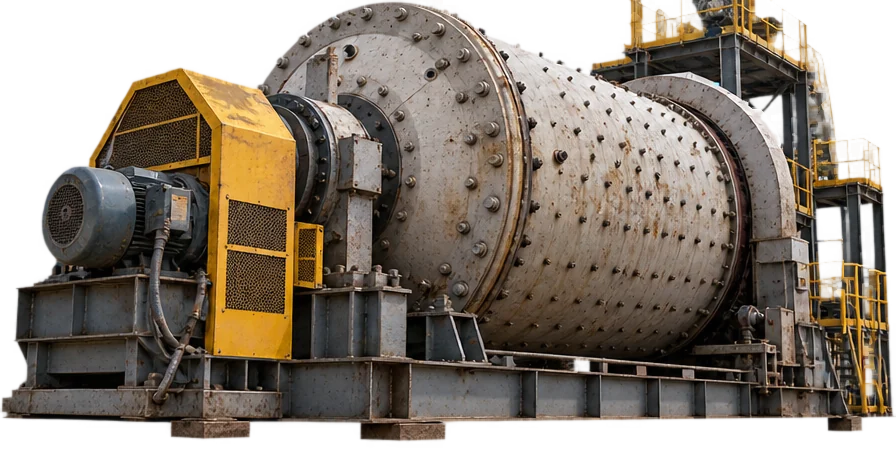
The cost of maintaining only when something breaks
Unplanned stoppages
Every unannounced failure stops production and forces repairs with whatever is in stock.
Poorly sized spares
The critical spare is missing on the day of the failure while slow movers pile up.
Replacements without data
Without accumulated cost per asset, replacement is decided on gut feeling.
From emergency repairs to a preventive plan that is kept
Online assessment
36 questions on equipment maintenance. When you finish you see your level by dimension.
30-minute review
Diego reviews with you how much of the work is corrective, how failures are recorded and whether critical spares have a minimum stock.
Maintenance workshop
With maintenance and stores we review the asset hierarchy, preventive plans, work orders and critical spares.
Selection and integration
We compare 2 to 4 options, from Odoo Maintenance to EAM platforms, and define the spare parts integration with ERP inventory.

Data, master records and access your company provides for a maintenance system
- Asset inventory with functional location, make, model and serial number
- Current preventive plans with frequencies and tasks
- Work order and failure history, even in spreadsheets
- Spare parts catalogue with stock and supplier
- Available readings from hour meters, mileage or sensors
Deliverables of the EAM/CMMS analysis, selection and integration
Asset hierarchy and criticality
Functional locations, assets and components, with a criticality matrix by impact on production, safety and cost.
Approved asset register
Maintenance plan
Preventive tasks per critical asset, calendar- or usage-based frequency, and associated spares.
Plan ready to load into the system
Work order flow
Request, approval, planning, execution and closure with hours, spares and failure cause.
Work order procedure
Selection and integration
Odoo Maintenance and specialised EAMs compared, and the link with ERP purchasing, inventory and accounting.
Decision matrix and integration map
Typical risks of a EAM/CMMS project and how they are controlled
Loading every asset at the same level of detail
ControlCriticality decides which assets get a detailed plan and which only corrective.
Work orders closed without data
ControlClosing requires hours, spares and a cause chosen from a short list.
Spares outside inventory
ControlCritical spares are coded in the ERP with a minimum and a location.
Scope limits and market options for EAM/CMMS
Limits
- We do not implement the chosen EAM; the vendor or its integrator does
- Predictive maintenance needs condition data, which comes from a separate IIoT project
- If the decision is Odoo Maintenance inside an Odoo we implement, it joins that project
Selection criteria
- Preventive plans by time, usage or condition
- Mobile app for technicians, online or offline
- Spare parts in the same ERP inventory
- MTBF, MTTR and cost-per-asset indicators
Odoo
Odoo Maintenance: equipment, requests and preventive plans, with spare parts in Odoo inventory. We assess it as one more option.
Other platforms on the market
- IBM Maximo
- SAP Plant Maintenance
- Infor EAM
- Fiix
- UpKeep
- eMaint
In no order of preference.
Equipment inspections and OHS records
- Inspections of safety and emergency equipment that feed the mandatory records of Law 29783
- In mining, equipment inspections and maintenance with the evidence required by the mining safety regulation (D.S. 024-2016-EM)
Systems that exchange data with a maintenance system
Enterprise resource planning
costs, purchasing and fixed assets
See the systemWMSWarehouse management system
spare parts and reservations per order
See the systemIIoTIndustrial IoT and data historian
equipment condition and alerts
See the systemSCADA/HMISupervisory control and data acquisition
running hours and alarms
See the systemFSMField service management
field technician orders
See the systemFMSFleet management
vehicle maintenance
See the systemMine FMSMine fleet dispatch and heavy equipment maintenance
mine equipment hours and states
See the systemEAM/CMMS assessment in 9 minutes
This assessment evaluates how you plan, execute and control maintenance for heavy fleet, equipment and facilities across operating sites. Questions cover hour meters, criticality, work orders, spare parts, recurring failures, costs and technical evidence.
Scored dimensions
- Hour-meter maintenance planning. Assesses whether preventive maintenance is scheduled and performed according to operating hours, calendar intervals and equipment condition.
- Asset register and criticality. Checks whether each asset has identification, operating location, technical hierarchy, maintenance history and function-based criticality.
- Work orders and execution. Examines how maintenance work orders are requested, assigned, executed and closed during shifts and maintenance windows.
- Remote-site spare parts. Assesses spare-part availability, reservation, consumption and replenishment for fleet and critical-equipment maintenance work orders.
- Failures and reliability. Determines whether functional failures, repair times and recurring causes are recorded to adjust maintenance strategies.
- Maintenance cost and evidence. Verifies traceability of labor, spare parts, contracted services and maintenance evidence by asset and operating site.
What you receive
At completion, you receive a management maturity level and a gap breakdown covering planning, assets, work orders, spare parts, reliability and costs. You also receive initial actions for reviewing processes and defining EAM/CMMS requirements and integration needs with inventory and ERP.
19 scored questions and 12 context questions (type of operation, size, current system). Context questions are not scored: they let us read the result against similar operations.
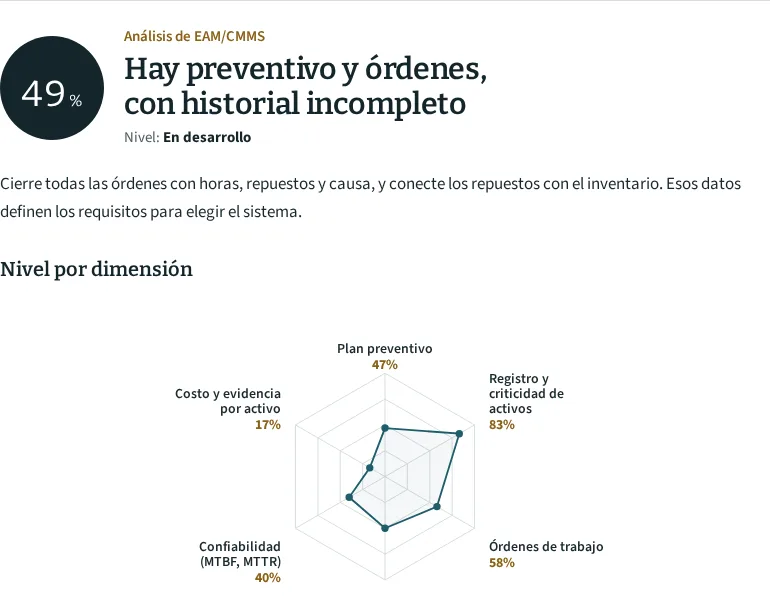
36 questions, 9 minutes
Example: if work orders are closed with no failure or cause code, the result flags Work orders and proposes a short code list before measuring MTBF.
Answers about EAM/CMMS
A CMMS manages maintenance; an EAM adds the asset lifecycle: purchase, cost, depreciation and replacement.
It requires sensors or readings on critical assets. It makes sense once preventive work and work orders are running.
A specialised EAM is implemented by its vendor. We build the asset hierarchy and criticality, the maintenance plan and the work order flow, and use them to review its configuration.
Review your EAM/CMMS result with Diego
Twenty minutes by video call or WhatsApp. Have at hand the list of critical assets and the current preventive plan.
Assessment first: the review uses your answers.