- Home
- Systems
- Supply chain
- FMS
Cost per kilometre, maintenance on schedule and no expired documents
A fleet management system controls vehicles, drivers, fuel, maintenance, documents and location. Diego analyses how you control your fleet today, helps you choose the tool and connects its data to the ERP.
39 questions · result by dimension · free

One record per vehicle with everything it costs
Fleet management brings together, per vehicle, the assigned driver, fuel with mileage, maintenance plan, documents with expiry dates, fines and claims. With telematics, GPS feeds that data automatically.
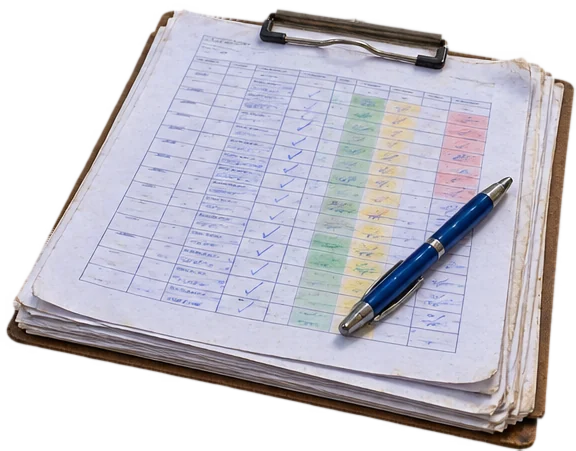
Without it, administration consolidates costs in Excel at month end and SOAT insurance and inspection expiries are checked from memory.
- 01Vehicle and driver register
- 02Fuel control
- 03Maintenance
- 04Documents and expiries
- 05GPS tracking
Processes it covers
Indicators that call for a FMS
These signs tend to coincide when each vehicle cost arrives through a different channel and nobody adds it up on the vehicle's record.
- Fuel is not controlled per vehicle
- SOAT insurance, inspections and licences expire without warning
- Maintenance happens when the vehicle breaks down
- There is GPS, but its data is not linked to anything
- Each vehicle's cost per kilometre is unknown
- Fines and claims are handled with no history
Company profile for a FMS, and when it is not a fit
Good fit
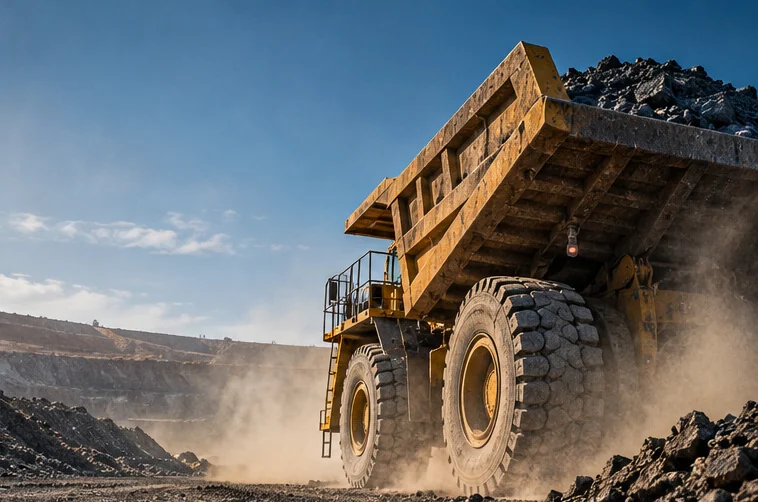
- Companies with their own delivery fleet, staff buses or machinery on construction or mine sites
- Fleets with GPS installed whose data reaches neither maintenance nor accounting
- Contractors who must prove each vehicle's valid documents to their client
Poor fit
- A few vehicles managed by one person: one record per vehicle in the ERP with expiry alerts is enough
- Leased fleet with maintenance included: control focuses on the contract and agreed mileage
- Heavy mining fleet with real-time dispatch: a mine dispatch system is the right fit
Cost of a fleet without a record per vehicle
Uncontrolled fuel
Without fuel economy per vehicle, abnormal consumption blends into normal spend.
Corrective instead of preventive
A vehicle that breaks down on the road leaves a job undone and a costlier repair.
Expired documents
A vehicle with expired SOAT insurance or inspection cannot be on the road and exposes the company if there is an accident.
FMS analysis method
The assessment follows one vehicle's cost over a month: fuel with mileage, preventive and corrective maintenance, documents, fines, accidents and telematics data.
Online assessment
39 questions on maintenance, fuel, documents, drivers and telematics. The result shows whether cost per kilometre can be calculated for each vehicle today.
30-minute review
Diego reviews the result with you and asks for the vehicle list with plates and one month's fuel vouchers. From that he shows which data point is missing for cost per kilometre.
Fleet and maintenance workshop
Half a day with fleet administration, workshop and operations: maintenance plan by mileage or hours, fuel control, SOAT insurance and roadworthiness test expiry dates and the data the GPS provides.
Selection and integration
Comparison of two to four fleet or telematics platforms using your vehicles, and connection of the chosen one to the ERP for cost per vehicle and cost centre.
Dimensions of the FMS assessment
Vehicle maintenance
Example: How is preventive maintenance scheduled and tracked for each vehicle?
Vehicle and driver register
Example: Do you have one vehicle register with plate, model, year, contract and insurance?
Fuel and usage
Example: How is fuel recorded?
Integration with GPS and accounting
Example: How do each vehicle's kilometres or operating hours reach the system?
Cost per kilometre and fuel economy
Example: Do you know the operating cost of each vehicle based on its use (per kilometre or per hour)?
Drivers and owners
Example: Who knows the status of the whole fleet?
Documents, fines and claims
Example: How do you track expiry of SOAT insurance, technical inspections, licences and permits?
Your company's inputs to a FMS project
Data
- Vehicle list with plate, type, year and current mileage
- Fuel vouchers or reports for recent months
- Expiry dates for SOAT insurance, roadworthiness tests and licences
People
- Fleet or transport manager
- Workshop manager or maintenance provider
Access and documents
- Read or export access from the GPS provider
- Accounts or cost centres where fleet costs are booked today
Diego's services in a FMS project
Record per vehicle
We define with you which data each vehicle and driver carries, and consolidate the fleet inventory with its documents and expiry dates.
Deliverable: vehicle and driver master with expiry dates
Cost per kilometre
We set how cost per kilometre is calculated: which costs count, where mileage comes from and how often it is reviewed.
Deliverable: cost-per-kilometre formula and its data source
Selection and integration
We compare fleet and telematics platforms on your vehicles and connect the chosen one to the GPS, the ERP and maintenance.
Deliverable: mileage and costs per vehicle without retyping
First month of telematics
During the first month we cross-check telematics mileage against the odometer and fuel vouchers of each vehicle, and check that each mileage-based service triggers on time.
Deliverable: acceptance tests with real vehicles
Scope
Dmunoz Group does not implement FMS platforms: the vendor configures them. Diego works on your company's side in the analysis, the choice, the ERP integration and checking the result.
Platforms we compare for a FMS
Odoo
Odoo Fleet: vehicles, contracts, services and costs per vehicle. It fits when the ERP is already Odoo and advanced telematics is not needed.
Other recognised platforms
- Samsara
- Geotab
- Fleetio
- Webfleet
- Verizon Connect
Comparison criteria
- Reading mileage, engine hours and alerts from the GPS or telematics you already have
- Preventive maintenance plan by mileage or hours, with work orders
- Fuel control by voucher or card, with consumption per vehicle
- Expiry alerts for SOAT insurance, roadworthiness tests, licences and rental contracts
The order of the list implies no preference. The choice of a fleet platform comes from your vehicle types, the installed GPS and the mileage source.
Systems a FMS exchanges data with
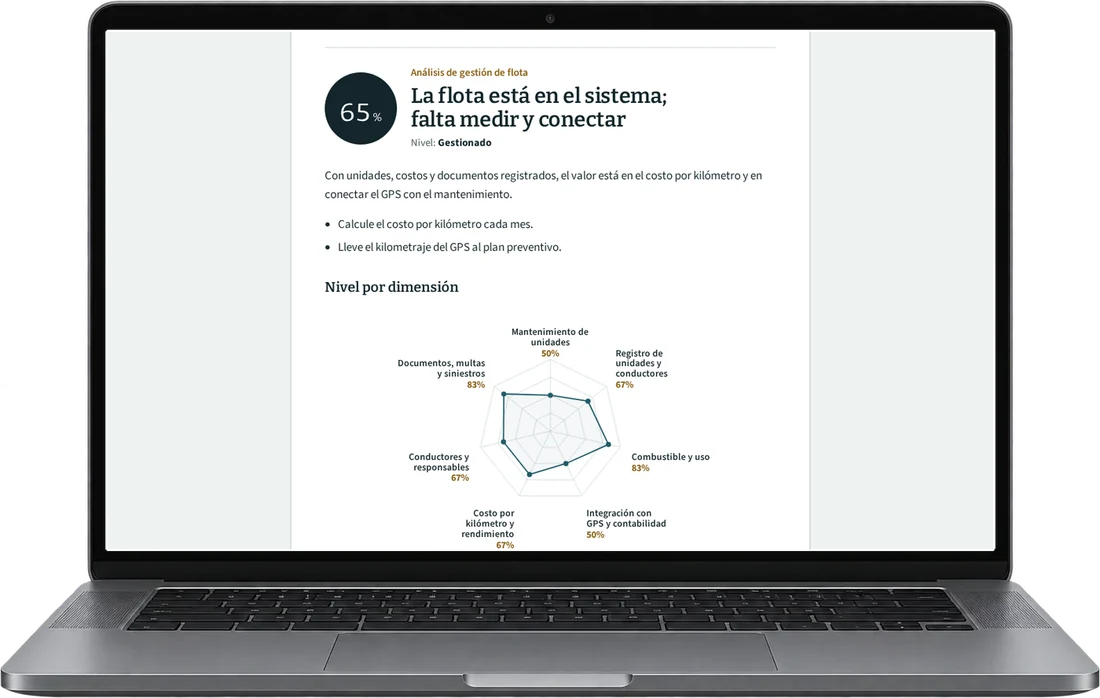
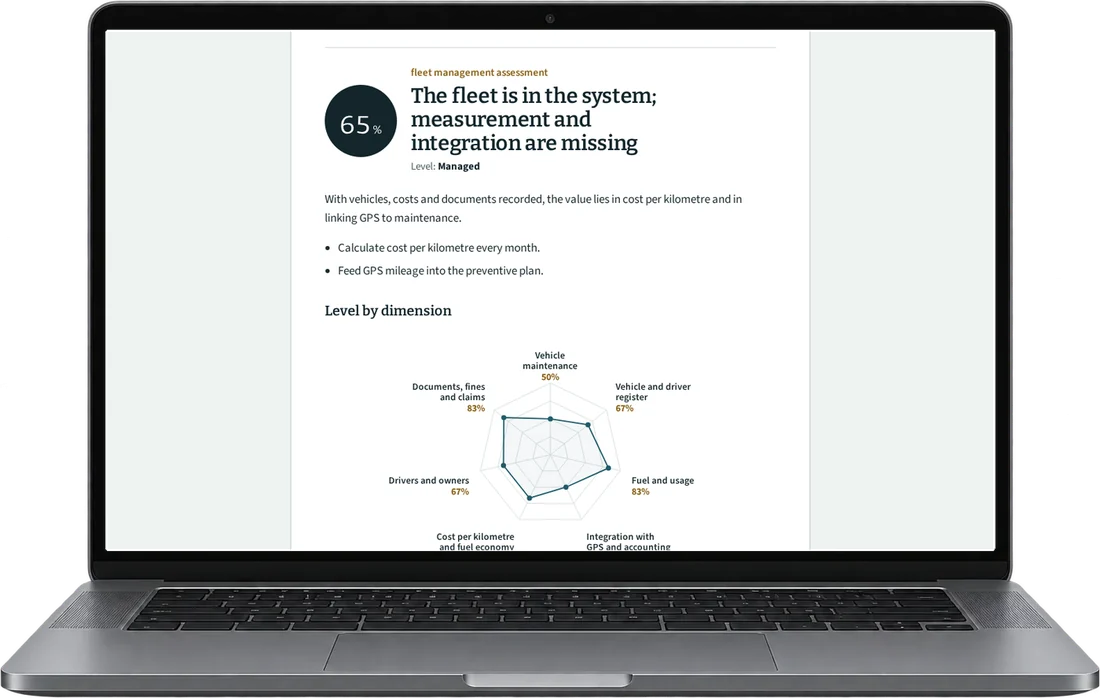
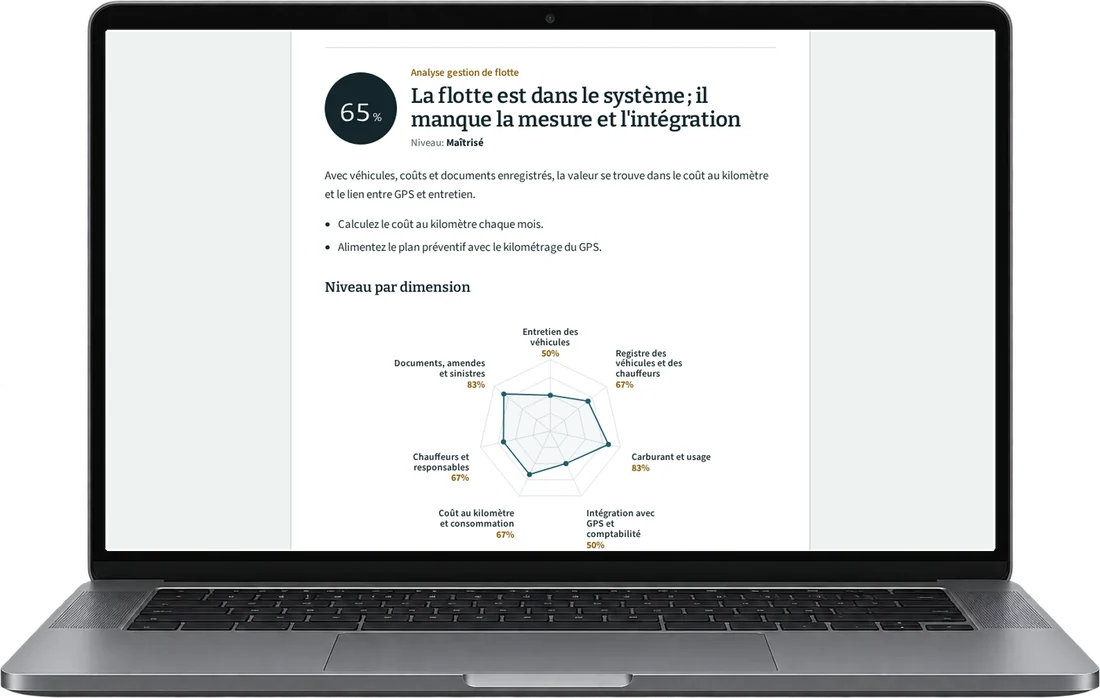
FMS assessment result in 39 questions
This assessment examines how vehicles and equipment are managed in mining, oil and gas and field-service operations. Questions cover hour-based maintenance, refueling, daily reports, telematics, costs, inspections and authorizations through observable operating situations.
Scored dimensions
- Condition-based maintenance. Assesses how maintenance is scheduled by operating hours, mileage or condition, and how equipment availability is restored.
- Asset identification and assignment. Checks whether each asset has an identifier, accountable person, contract, operating location and assignment history.
- Fuel and spare parts. Examines fuel, lubricant, spare-part and repair records by asset and their relationship with completed work.
- Telematics and cost allocation. Evaluates how usage readings are collected and how fleet expenses are linked to assets, contractors and cost centers.
- Availability and operating cost. Checks whether cost per operating hour or kilometer, fuel efficiency and equipment downtime are calculated.
- Inspections and compliance. Reviews pre-shift inspections, defect reporting and the validity of vehicle documents and driver authorizations.
What you receive
On completion, you receive a dimension-level assessment identifying gaps and the first actions to verify in your operation. The result guides the evaluation of Odoo Fleet or specialized maintenance and telematics tools, including ERP integration, without assuming that one platform meets every requirement.
18 scored questions and 16 context questions (type of operation, size, current system). Context questions are not scored: they let us read the result against similar operations.
Common questions about a FMS project
Most GPS providers offer a way to export or query data. The first step is to bring mileage and hours into the maintenance plan without retyping them.
Control includes contracts, agreed mileage and return conditions. They are recorded on each vehicle's record with their due dates.
Telematics fleet platforms are installed by their vendor. Diego defines requirements with you, compares options and connects the data with your ERP and maintenance.
The online FMS assessment and the 30-minute review are free. If a workshop or a project makes sense afterwards, you get a proposal with scope and deliverables before deciding.
Only Diego Muñoz sees your answers on maintenance, fuel and vehicle assignment, to prepare the review. They are not shared with third parties or used for bulk mailings.
A 30-minute FMS review with Diego
Take the assessment and book the review with your vehicle list. Diego Muñoz replies in person, on Lima time.
WhatsApp +51 919 488 260 · damunoz@dmunozgroup.com