Your online store connected to stock, payment and invoice
We analyze your online sales, help you choose the platform and connect it to your ERP, payment gateway and e-invoicing.

35questions, 9 minutes and your result at the end
Signs your company needs one
- Web orders are keyed into the ERP again
- The store sells out-of-stock products
- Prices and promotions differ between the website and the store
- Online payment reconciliation is done by hand
- Receipts for web sales are issued late
- You sell on marketplaces with no central stock control
Company profile for e-commerce, and when it is not a fit
Good fit
- You already sell through social media or WhatsApp and orders are noted by hand.
- You sell in your own store and on marketplaces from the same stock.
- Web orders are keyed in again in the ERP to invoice them.
Poor fit
- Each sale needs a tailored quote: a CRM with quoting fits better.
- Nobody can answer and ship orders every day: an open store creates complaints.
- The catalog has no photos or listings: the content comes first.

The cost of staying as you are
Overselling
Selling what you don't have means canceling, refunding and explaining, and leaves the customer with a bad experience.
Double keying
Every order copied by hand into the ERP takes someone's time and risks an error in price, address or receipt.
Payments that don't balance
Fees, batched deposits and failed payments are discovered at closing, when it is too late to claim.
E-commerce analysis in four steps
Process and data first, the tool second. Each step ends in a deliverable you review.

Five orders, end to end
We follow five real orders from payment to delivery and note each manual copy, each wait and each system they touch.
Catalog, stock and prices
We review where product data, published stock and price lists per channel come from.
Platform and requirements
We compare platforms against your requirements and your ERP, and tell you what connects out of the box and what needs development.
Proven integration
We connect stock, orders, payments and receipts in a test environment, with alerts when something fails, before going live.
Your company's inputs to the e-commerce project
The list is confirmed at the first meeting and adjusted to your case.
Data
- Catalog with codes, photos, sizes and attributes
- Pricing, promotion and shipping cost rules
- Stock by warehouse or store
People
- A store manager with time set aside
- The person who ships and sets lead times and carriers
Access
- Accounts for the platform, the payment gateway and marketplaces
- Access to the ERP and the e-invoicing system
E-commerce assessment, selection and integration
We assess, choose with you and integrate
Scope
We analyze your online sales, help you choose the platform (Shopify, WooCommerce, VTEX or Odoo eCommerce, among others) and connect it to your ERP, stock, payments and e-invoicing. The store is built by the platform or your agency; we take care of the integrations.
Online sales assessment
Order journey, catalog, stock, payments and receipts, with the list of integrations ranked by volume.
Platform selection
Comparison of two to four options against your requirements, your ERP and the three-year cost.
ERP integration
Stock, orders, payments and e-invoicing connected, with monitoring and an owner for each connection.
Market options for e-commerce
In no order of preference. The choice comes from your requirements, your budget and the systems you already have.
Odoo eCommerce
Odoo eCommerce shares products, stock, prices and customers with the ERP, so the web order is already in the system. It fits when the company uses Odoo; if your store is on another platform, we connect it.
Other platforms we assess
- Shopify
- WooCommerce
- VTEX
- Adobe Commerce (Magento)
- Salesforce Commerce Cloud
- BigCommerce
Selection criteria
- Connection to your ERP: stock, orders and customers
- Payment gateways available in Peru
- Electronic receipt issued with the sale
- Marketplaces you need to connect
E-commerce limits and ways to cover them
The store does not fix untidy stock
Stock is cleaned up in the ERP before it is published.
Each marketplace requires its own catalog format
Attributes are mapped per channel; at high volume a PIM is assessed.
The store platform is implemented by its provider or your agency
We assess, help you choose and connect the store to the ERP, stock and invoicing.
Connections between e-commerce and other systems
Enterprise resource planning
The web order arrives with customer, products and payment.
See the systemPayment gateways and terminals
Payment is confirmed and reconciled with the order.
See the systemWarehouse management system
The warehouse receives the order to pick and dispatch.
See the systemProduct information management
Complete product data is published on every channel.
See the systemE-invoicing (SUNAT/OSE)
The receipt goes out with the sale.
See the systemE-commerce assessment: 35 questions, 9 minutes
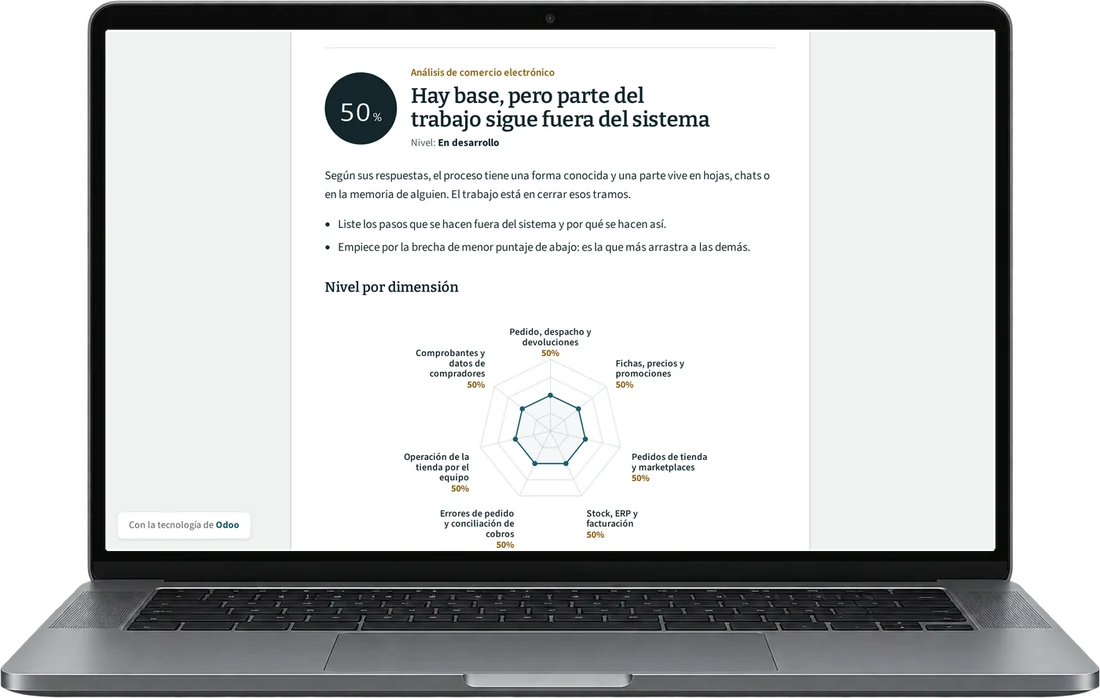
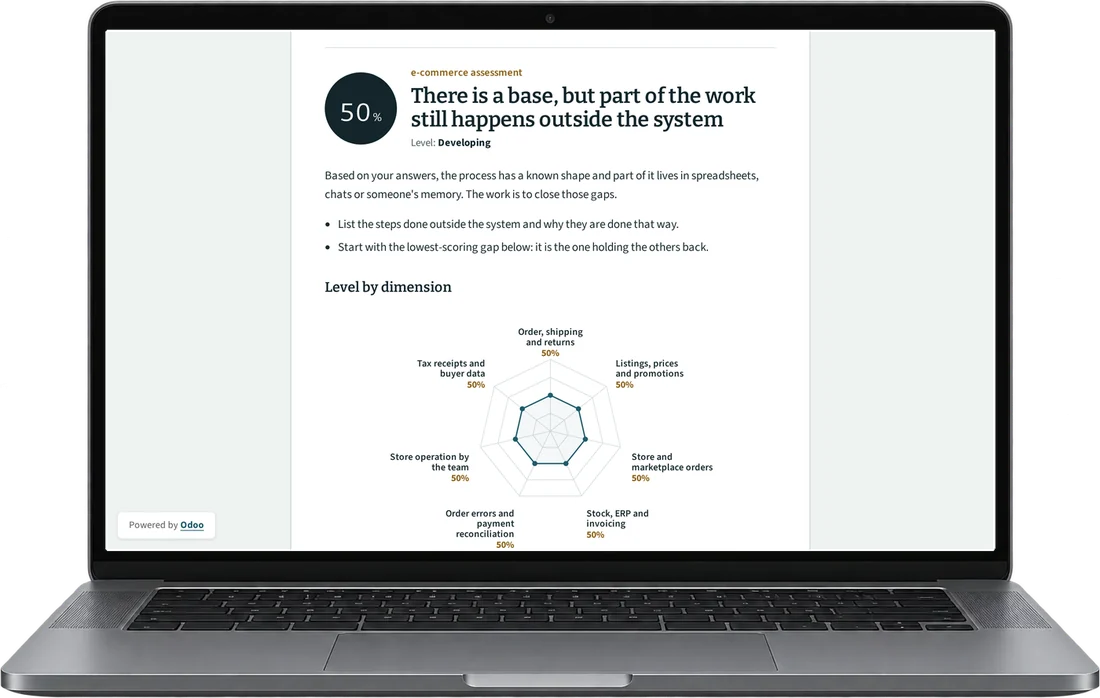
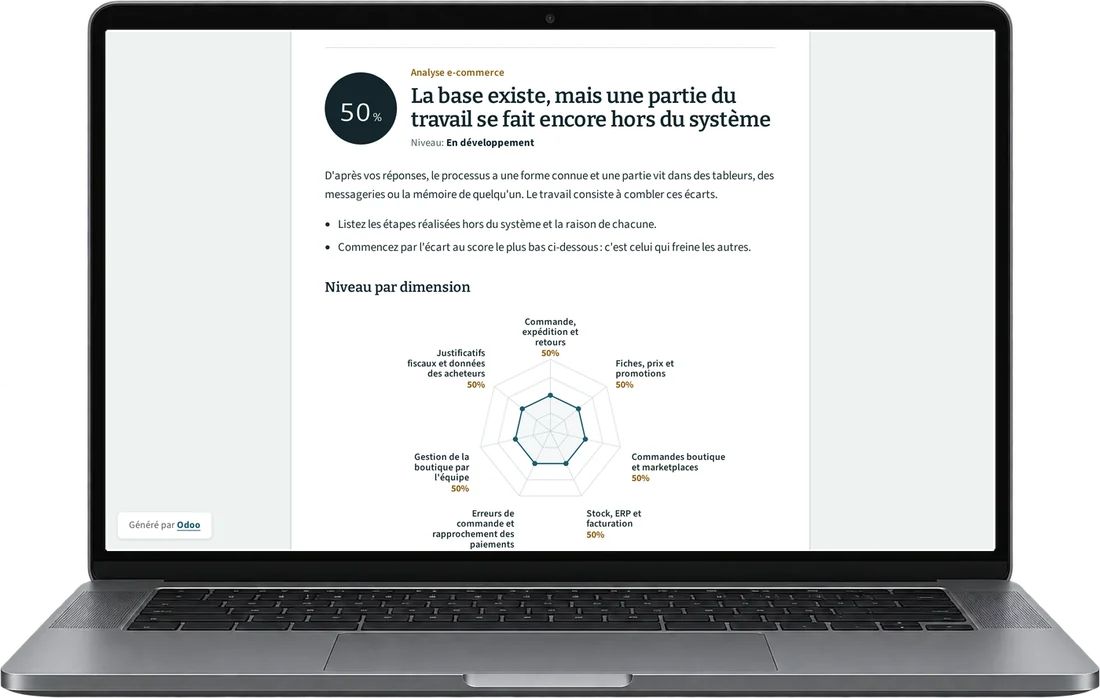
This analysis reviews your online sales, from product page and published stock to shipping, payment and receipt. The questions describe what happens to a web or marketplace order in your operation.
Scored dimensions
- Catalog, prices and promotions. Looks at whether product pages come from a master with mandatory attributes and whether prices and promotions are set once per channel.
- Picking, shipping and returns. Looks at whether each web order follows timed steps through courier delivery or store pickup, with customer notices and returns tied to the order.
- Published stock per channel. Looks at whether the website and marketplaces show real warehouse and store stock, and whether orders from all channels reach the same system.
- Payment, reconciliation and receipt. Looks at whether a paid order reaches the ERP with its e-receipt and whether payouts from the gateway, marketplace and courier are matched to each order.
- Store operation and access. Looks at how many people can run the store, how campaigns are prepared and who has access to the admin panel and buyer data.
What you receive
When you finish, you receive your level in five online channel dimensions and the gaps ranked by weight. Each gap indicates a first action your team can check.
17 scored questions and 13 context questions (type of operation, size, current system). Context questions are not scored: they let us read the result against similar operations.
Free of charge. Only Diego Muñoz sees your answers.
Common questions about e-commerce
If your question is not listed, Diego answers it on WhatsApp during Lima business hours.
We analyze, help you choose and build the integrations with your ERP. The store's design and launch are done by the platform or your agency, coordinated with us.
Yes, through APIs, with existing or custom connectors. We first review your platform's API and tell you what can be automated.
Each integration retries and, if it cannot, alerts an owner with the pending record. No order is lost silently.
The online assessment and the 30-minute review with Diego are free and carry no commitment.
Only Diego Muñoz sees them, to prepare the review. They are not shared with third parties or used for bulk mailings.
Review your case with Diego in 30 minutes
Diego Muñoz replies in person, on Lima time. If you have taken the assessment, he comes with your answers already read.
WhatsApp +51 919 488 260 · damunoz@dmunozgroup.com