One product record for every channel
We analyze how your product information is created and published and help you choose between your ERP and a specialized PIM.
36questions, 9 minutes and your result at the end
Signs your company needs one
- The same product has different descriptions on the website and marketplace
- Images and data sheets sit in shared folders
- Launching a product online takes weeks
- Marketplace attributes are filled in by hand
- Suppliers send data in different formats
- Nobody owns catalog quality
Company profile for PIM, and when it is not a fit
Good fit
- You publish hundreds or thousands of products across several channels.
- Each marketplace asks for different attributes and rejections are fixed by hand.
- Photos and data sheets live in folders and emails.
Poor fit
- You publish on one channel with a short catalog: the ERP or the store is enough.
- Nobody owns product content: the PIM would stay empty.
- The ERP product master has duplicates: it gets cleaned up first.

The cost of staying as you are
Products that don't sell
A product without complete data is not published, or is rejected by the marketplace, even with stock on hand.
Returns caused by data
A wrongly published dimension or compatibility ends in a return and a customer who distrusts the product page.
Repeated hours
Every change of price, photo or description is made once per channel, by the same person.
PIM analysis in four steps
Process and data first, the tool second. Each step ends in a deliverable you review.

Walk through a product launch
We follow a recent product from its ERP code to publication on each channel, with times and owners.
Attribute dictionary
We define the mandatory attributes per channel and measure the current completeness of your main products.
ERP or PIM
We compare what your ERP can do with two or three PIMs, based on the number of products, channels and languages.
Decision and connection
We deliver the decision matrix; with the chosen tool, we coordinate with the provider and connect the catalog to your ERP and store.
Your company's inputs to the PIM project
The list is confirmed at the first meeting and adjusted to your case.
Data
- ERP product master with its codes
- Current photos, data sheets and descriptions
- Attributes each channel requires
People
- A product content owner
- Purchasing or product, who know composition and sizes
Access
- Access to the ERP and to store and marketplace back offices
- Current image folder or repository
PIM assessment and selection
We assess and help you choose
Scope
We analyze how your product information is created and published, define attributes per channel and help you choose between the ERP and a specialized PIM. We coordinate with the provider and connect the tool to your ERP and store; we do not offer our own PIM implementation.
Catalog assessment
Completeness per channel, duplicate codes, image sources and creation flow, with the list of fixes.
Tool selection
Your ERP against specialized PIMs, with a demo on your products and the three-year cost.
ERP and channel integration
Coordination with the provider and connection of the catalog to the ERP master, store and marketplaces.
Market options for PIM
In no order of preference. The choice comes from your requirements, your budget and the systems you already have.
Odoo Inventory and eCommerce
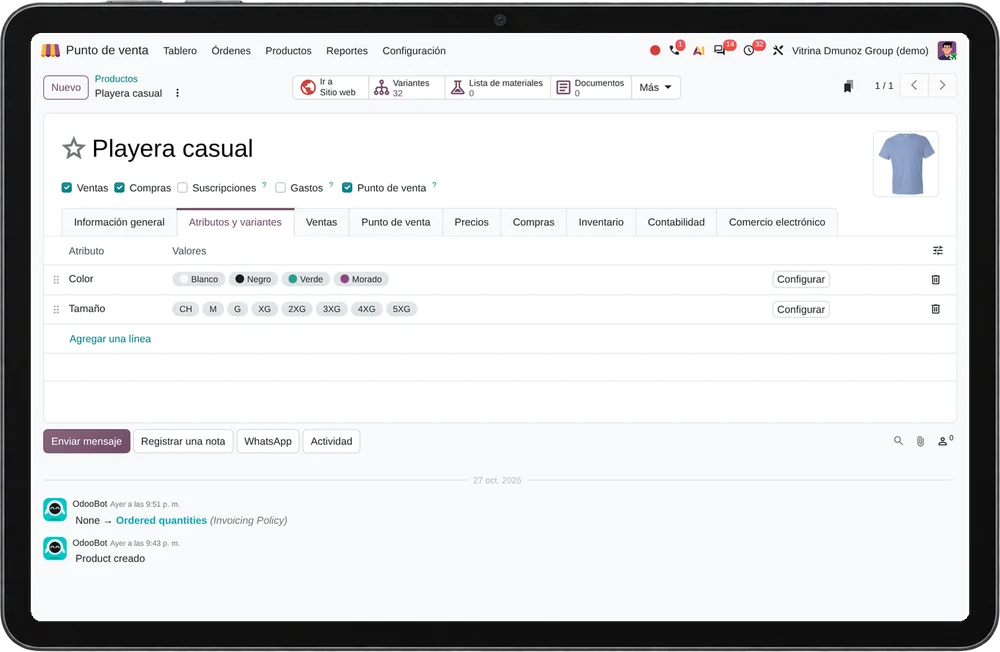
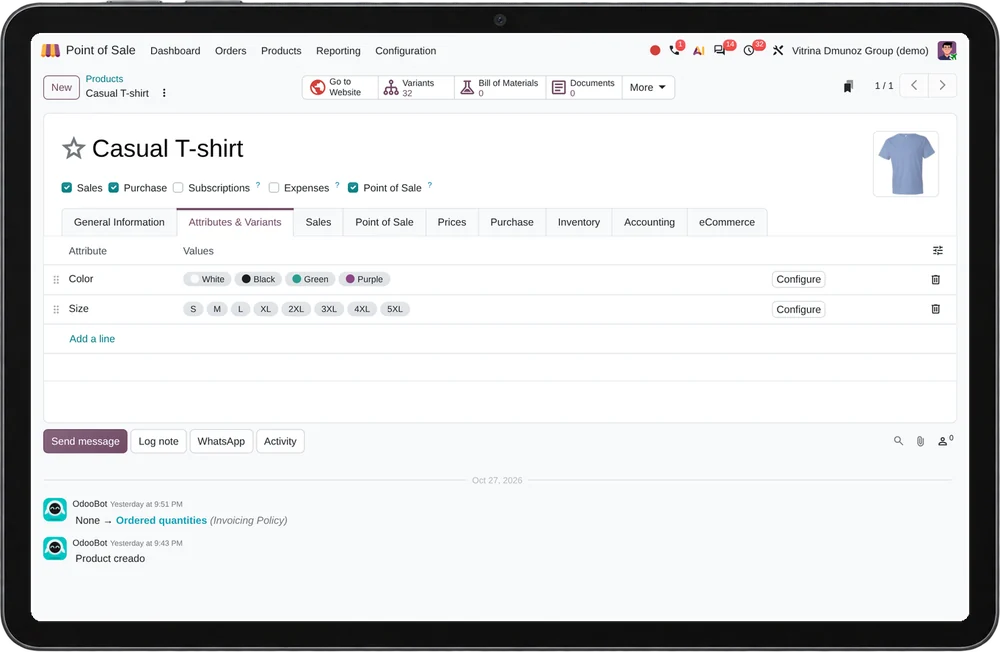
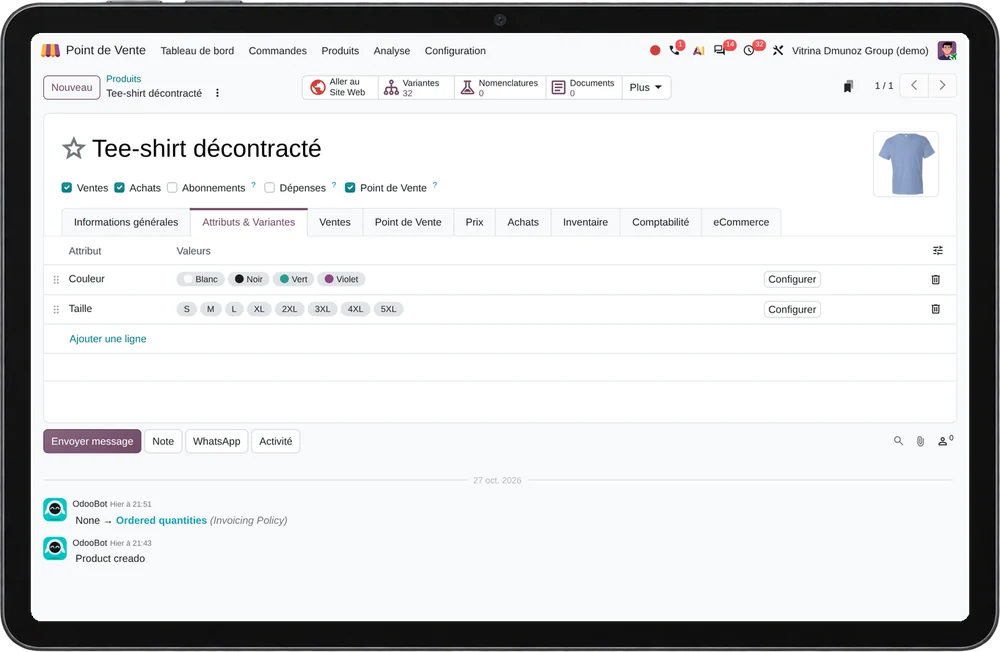
Odoo Inventory and eCommerce handle attributes, variants, images and per-language descriptions on the same ERP product record. For thousands of products on many channels, it is compared with specialized PIMs.
Other platforms we assess
- Akeneo
- Salsify
- inRiver
- Pimcore
- Syndigo
- Stibo Systems
Selection criteria
- Number of products, channels and languages
- Connectors to your store and marketplaces
- Approval workflow and completeness per channel
- A clear split between what the ERP owns and what the PIM owns
PIM limits and ways to cover them
A PIM does not write the listings
A content guide is set, along with who completes each attribute.
Prices and stock stay outside the PIM
They live in the ERP; the PIM takes product codes from there.
No in-house implementation of a PIM
We define the attribute model, compare options and coordinate with the provider; we connect the PIM to the ERP.
Connections between PIM and other systems
Enterprise resource planning
Code, price and stock come from the ERP.
See the systemE-commerce
The store publishes the complete record.
See the systemMaster data management
The product master has a single owner.
See the systemProduct lifecycle management
Technical data comes from engineering.
See the systemDocument and enterprise content management
Data sheets and certificates with versions.
See the systemPIM assessment: 36 questions, 9 minutes
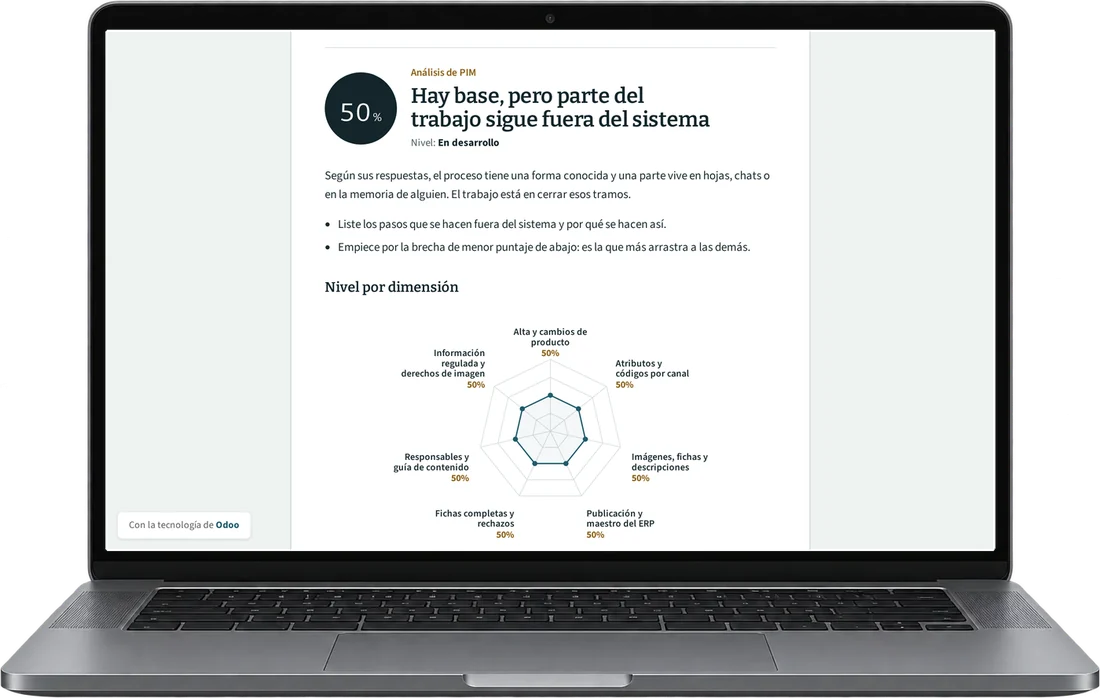
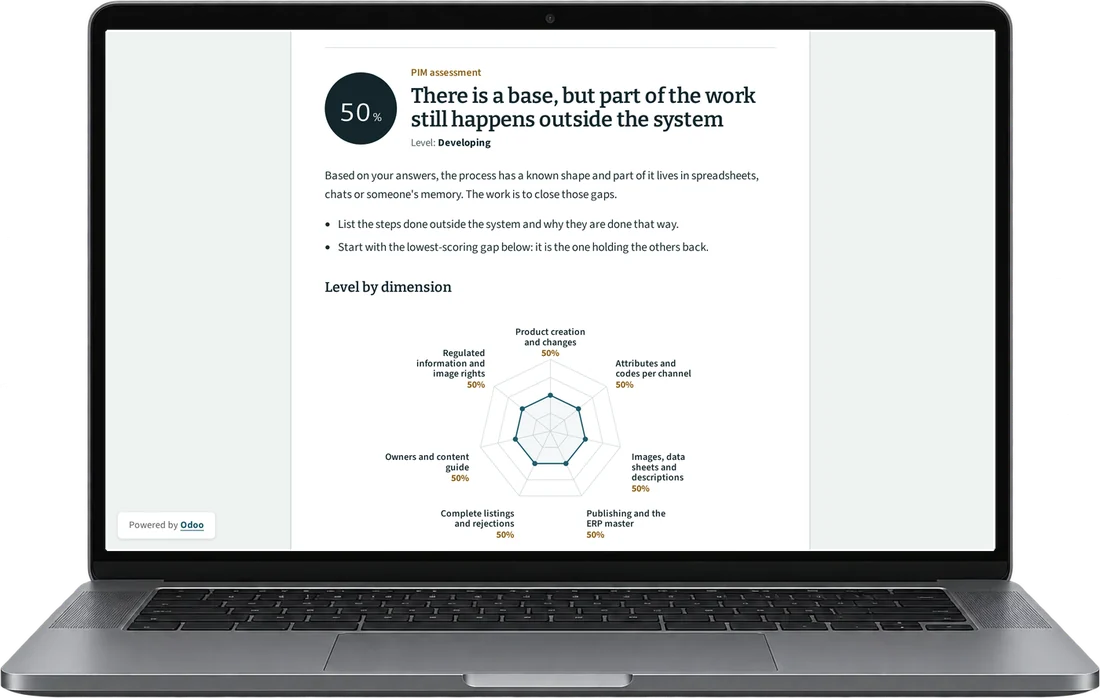
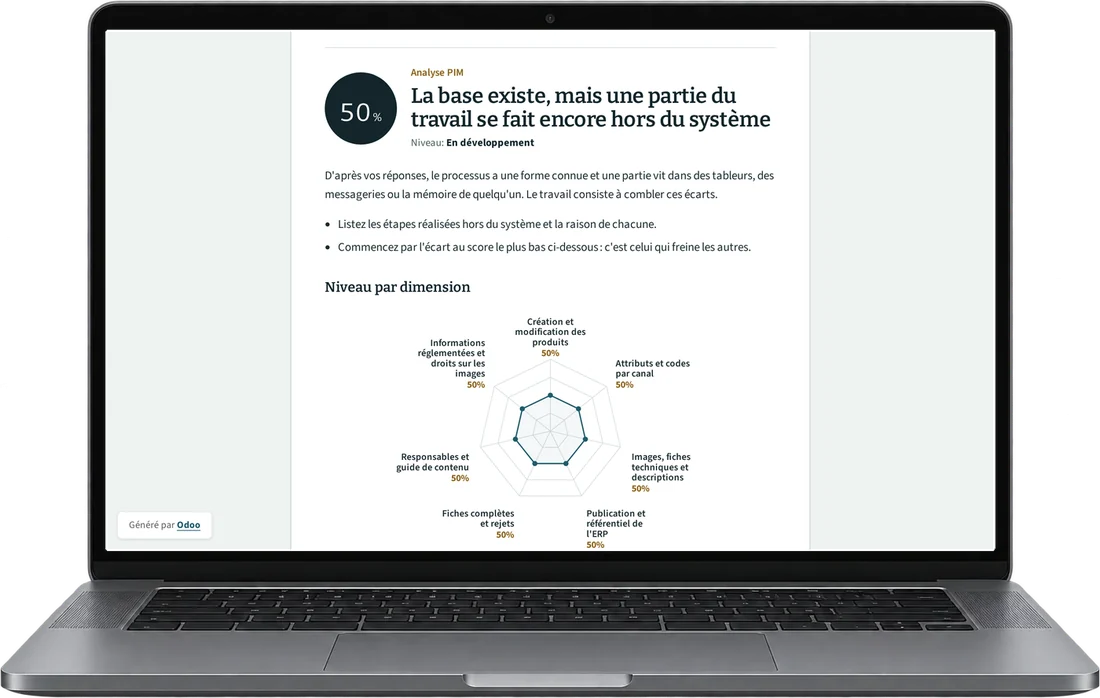
This assessment reviews how each SKU record is created, completed and published in store, web and marketplaces. The questions describe observable catalog situations, from loose sheets to a single record measured by channel.
Scored dimensions
- Product setup and changes. It follows a SKU from the moment purchasing codes it until it shows in store, web and marketplace, and how each later change travels.
- Attributes, variants and codes. It checks whether each product family has mandatory attributes per channel, organized variants and a single mapping between the ERP code, the EAN and each marketplace's code.
- Photos and sales copy. It checks where each SKU's photos, data sheets and descriptions are stored, whether they are linked to the product and under what rights they are used.
- Publishing and ERP master. It checks how the record moves from the ERP to the online store, the marketplaces and the store POS, and which system owns each field.
- Catalog quality and governance. It checks whether complete records per channel are counted, marketplace rejections are logged and there are owners, a writing guide and review of sensitive information.
What you receive
When you finish you get your level in each catalog dimension and the ranked gaps. Each gap comes with a first action your team can verify.
17 scored questions and 14 context questions (type of operation, size, current system). Context questions are not scored: they let us read the result against similar operations.
Free of charge. Only Diego Muñoz sees your answers.
Common questions about PIM
If your question is not listed, Diego answers it on WhatsApp during Lima business hours.
Not always. With few channels and hundreds of products, the ERP is usually enough if attributes and owners are defined. The assessment tells you with your numbers.
We do not offer our own PIM implementation. We define attributes and flow, help you choose, coordinate with the provider and connect to your ERP.
With the attribute dictionary for your top ten products on each channel. It is useful with or without a new tool.
The online assessment and the 30-minute review with Diego are free and carry no commitment.
Only Diego Muñoz sees them, to prepare the review. They are not shared with third parties or used for bulk mailings.
Review your case with Diego in 30 minutes
Diego Muñoz replies in person, on Lima time. If you have taken the assessment, he comes with your answers already read.
WhatsApp +51 919 488 260 · damunoz@dmunozgroup.com