One record for each customer, product and supplier across all your systems
I clean and organise your master data inside the ERP, agree rules and owners with the departments, and help you decide whether you need an MDM platform and connect it.
35questions on record creation, duplicates and data owners, in 8 minutes
The official version of the data every transaction uses
Master data management (MDM) defines and maintains a single version of customers, suppliers, products and accounts: who creates them, which fields are mandatory, how duplicates are prevented and how changes reach each system.
It is more a practice than a tool. Many companies handle it inside the ERP with rules and owners; a dedicated MDM platform makes sense when many systems share the same data.
Signs your company needs one
- There are duplicate customers across sales channels or companies
- Products have different codes depending on the system
- Contacts with a tax ID have a national ID recorded, or the other way round
- Nobody is responsible for approving new master data
- A migration forces you to clean thousands of records
- Reports change depending on which copy of the data is used
MDM: who it is for and when it does not fit
A good fit for
- Companies with several legal entities or sales channels that share customers and products
- Sales, purchasing and credit teams that create master data without a common rule
- Migration projects to a new ERP that inherit years of duplicate records

Not a fit when
- There is a single system and few people create master data: rules and validations inside the ERP are enough
- An MDM platform is sought before agreeing who owns each piece of data
- The real problem is a sales or purchasing process that bypasses the system
The cost of staying as you are
Errors that multiply
A wrongly entered master record repeats in every order, invoice and shipment that uses it.
Split history
With a duplicate customer, their credit and purchases are split and no report adds them up correctly.
Migrations that drag on
Changing systems with uncleaned master data forces a last-minute clean-up or carries the mess into the new system.
How I assess MDM in four steps
Current quality is measured before any record is touched, and each rule has a department that answers for it.
I measure the current state
Duplicates, empty fields and invalid IDs in each master, with figures from your own database.
I agree rules and owners
Mandatory fields, naming, who approves and which record survives a duplicate.
I clean in the ERP
Merging duplicates, validating IDs and alerts at creation, with a prior backup.
I decide on the platform with you
Whether the ERP is enough or an MDM platform is needed, with requirements and connection to the other systems.
What your company provides for the master data management project
Master data export
Customers, suppliers and products from each system, with creation date and last transaction.
One owner per type of master data
Who approves a new customer, a new product and a new supplier.
Business criteria for merging
When two records are the same customer: tax ID, registered address, branch or channel.
Time from the departments
Short sessions to review doubtful cases the automatic rule cannot settle.
Assessment, selection and integration
Data quality assessment
Counts of duplicates, incomplete fields and invalid IDs per master.
Clean-up and governance in the ERP
Creation rules, owners, duplicate merging and validations at creation.
Selection and integration
Requirements for an MDM platform and its connection to ERP, CRM and online store.

Diego Muñoz
I do not implement dedicated MDM platforms. I clean and govern master data inside the ERP and during migrations, help you decide whether an MDM platform adds value, and connect it to your ERP, CRM and online store.
I assess, choose with you and integrate
Take the assessmentMarket options
MDM platforms differ in the domain they cover best (customers or products), in how they merge records and in their ERP connectors.
Odoo Contacts and Products
Within Odoo, contacts and products are kept in order with duplicate rules, mandatory fields and ID validation. When the company runs almost everything in Odoo, this is usually enough without a separate MDM platform.
Other platforms I assess
- Informatica MDM
- Reltio
- Stibo Systems STEP
- Profisee
- Semarchy
- SAP Master Data Governance
Selection criteria
- How many systems share the same master data
- Record volume and rate of new entries
- Approval flows and owners per master
- Matching rules to detect duplicates
- Connectors to ERP, CRM and e-commerce
MDM: limits and alternatives
Dedicated MDM platforms
I do not implement them. I prepare the requirements and the connection; the vendor configures the platform.
External data
Validation against SUNAT or RENIEC registries depends on the lookup service your company subscribes to.
Accounting history
Merging contacts with closed journal entries requires accounting care; some duplicates are archived instead of merged.
Which other systems it connects to
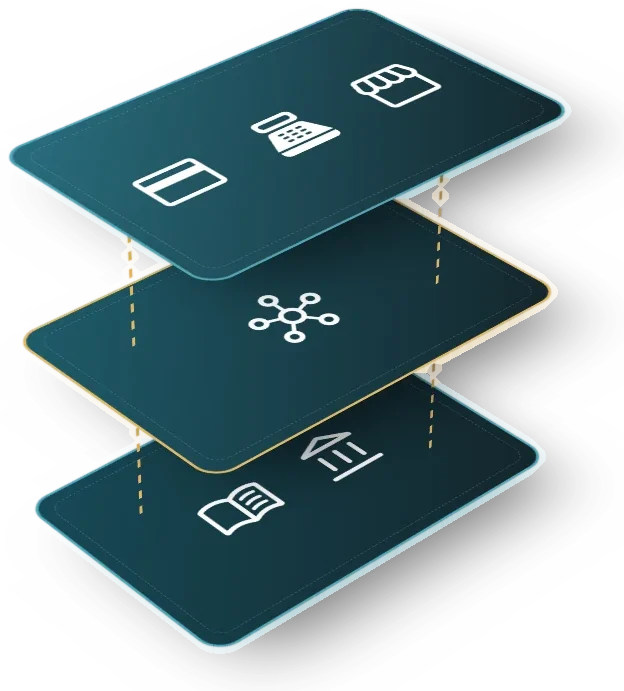
Enterprise resource planning
The official record of customers, suppliers, products and accounts in most mid-sized companies.
See the systemCustomer relationship management
Customers and contacts that originate in sales and must match those in billing.
See the systemProduct information management
Product attributes, images and descriptions for sales channels.
See the systemBusiness intelligence and data warehouse
Totals by customer and product that duplicates do not split.
See the systemIntegration platforms (iPaaS/ESB) and APIs
Syncing changes from the official record to each system.
See the systemCustomer data platform
A unified customer profile built on clean master data.
See the system35 questions and 8 minutes to see where to start
This assessment reviews how your inputs, products, customers and suppliers are created, cleaned and shared. The questions describe observable situations in creation, duplicates, official source, owners and permissions.
Scored dimensions
- Creation and lifecycle. It looks at whether each input, product, customer or supplier is created from a request with minimum data and approval, and whether it is deactivated by a rule when no longer used.
- Duplicates and identity documents. It looks at how often the same record appears twice, whether RUC tax IDs and DNI numbers are reliable and whether the system warns before a similar record is created.
- Official source and synchronization. It looks at whether each data item has a system of record, whether codes of the same product are linked across systems and whether changes travel automatically with conflict alerts.
- Data owners and measurement. It looks at whether each master has a business owner with authority, whether those who create records know the rules and whether quality and creation time are measured.
- Permissions and change history. It looks at who can create or modify master data and whether user, date and previous value are logged on sensitive fields.
What you receive
At the end you receive your master data level across five dimensions and the gaps ranked by weight. Each gap states a first action your team can check.
17 scored questions and 13 context questions (type of operation, size, current system). Context questions are not scored: they let us read the result against similar operations.
Free of charge. Only Diego Muñoz sees your answers.
Before you start
No. I clean and govern master data inside the ERP and during migrations. If your case needs a dedicated MDM platform, I write the requirements, help you choose and connect the platform to your systems; the vendor implements it.
Before. Migrating without a prior clean-up is one of the best-known risks: it carries duplicates into the new system, where merging costs more because they already have transactions attached.
It depends on the rule you agree. Sharing contacts between companies avoids duplicates but requires clear access rules; separating them simplifies permissions but means maintaining copies. The rule is set during the assessment.
The online assessment and the 30-minute review with Diego are free and carry no commitment.
Only Diego Muñoz sees them, to prepare the review. They are not shared with third parties or used for bulk mailings.
Review your MDM case with Diego in 30 minutes
Diego Muñoz replies in person, on Lima time. If you have taken the assessment, he comes with your answers already read.

WhatsApp +51 919 488 260 · damunoz@dmunozgroup.com