One customer, whether they buy in store, online or in the app
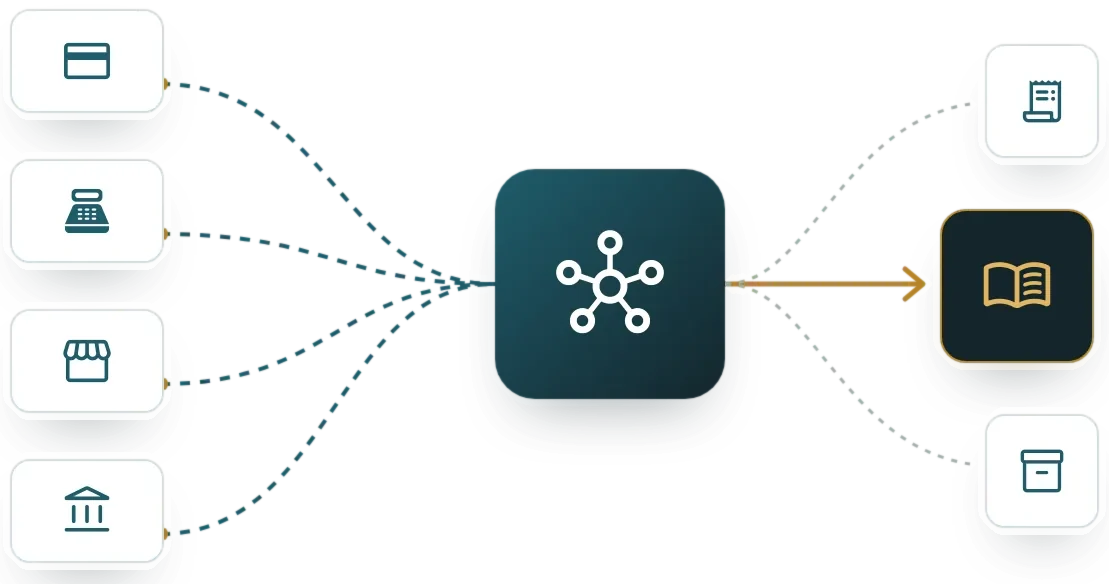
We analyze your customer data sources and use cases, and help you decide whether you need a CDP or whether your CRM and a data warehouse are enough.
34questions, 9 minutes and your result at the end
Signs your company needs one
- The customer is duplicated across store, web, app and CRM
- Segments combining purchases and web behavior can't be built
- Campaigns offer products the customer already bought
- Personal data consent is not centralized
- Each marketing tool has its own list
- Customer lifetime value is not measured
Company profile for CDP, and when it is not a fit
Good fit
- You hold customer data in stores, web, app and CRM with no common view.
- Marketing asks IT for segments and they take days.
- You have written use cases that need behavioral data.
Poor fit
- All your customers are already in a CRM or ERP: a CRM with segments can be enough.
- There are no defined use cases: an unused CDP is an expensive store.
- You do not identify the customer in most sales: capture comes first.

The cost of staying as you are
Campaigns that annoy
Offering what the customer already bought, or writing on three channels at once, wears the relationship down.
Investment without use cases
A platform bought before deciding what to do with the data ends up loading data nobody activates.
Legal risk
Joining data from several sources without centralized consent can use data for purposes the person never authorized.
CDP analysis in four steps
Process and data first, the tool second. Each step ends in a deliverable you review.

Use cases first
With marketing and sales we write three to five use cases with segment, channel and indicator.
Source inventory
We list the customer data sources, their identifiers and quality, and test the matching rule on a sample.
CDP, CRM or data warehouse
We compare a CDP with what your CRM and a data warehouse can do for those use cases, with three-year cost.
Consent and decision
We define consent and retention rules, and deliver the decision matrix to choose with the provider.
Your company's inputs to the CDP project
The list is confirmed at the first meeting and adjusted to your case.
Data
- Inventory of sources holding customer data
- Record samples from each source
- Prioritized use cases
People
- A customer data owner
- Someone in IT who knows each source
Access
- Read access to each source database or API
- Personal data register and privacy policies
CDP assessment and selection
We assess and help you choose
Scope
We analyze your customer data sources, define use cases and identity and consent rules, and help you decide whether you need a CDP or whether your CRM and a data warehouse are enough. We coordinate with the provider and connect to your CRM and ERP; we do not offer our own CDP implementation.
Use cases and sources
Written use cases, a source inventory and a test of the matching rule on a sample of your data.
Tool selection
Decision matrix between CDP, CRM and data warehouse based on your use cases, volume and budget.
Integration and consent
Coordination with the provider, connection to your CRM and ERP, and consent rules by purpose and channel.
Market options for CDP
In no order of preference. The choice comes from your requirements, your budget and the systems you already have.
Other platforms we assess
- Segment (Twilio)
- Salesforce Data Cloud
- Adobe Real-Time CDP
- Bloomreach
- Treasure Data
- Tealium
Selection criteria
- Use cases covered without development
- Connectors to your sources and campaign channels
- Identity and consent management
- Cost per profile or per event over three years
CDP limits and ways to cover them
A CDP does not clean data nobody governs
An owner is named and identity rules are set before loading sources.
A CDP does not replace the CRM or the ERP
It takes data from them and returns segments; transactions stay where they are.
No in-house implementation of a CDP
We define use cases and requirements, compare options and coordinate with the provider.
Connections between CDP and other systems
Customer relationship management
The unified profile reaches the customer record.
See the systemMarketing automation
Segments are activated in sequences.
See the systemE-commerce
Web behavior is added to the profile.
See the systemPoint of sale
Store purchases join web purchases.
See the systemBusiness intelligence and data warehouse
The data warehouse keeps history for analysis.
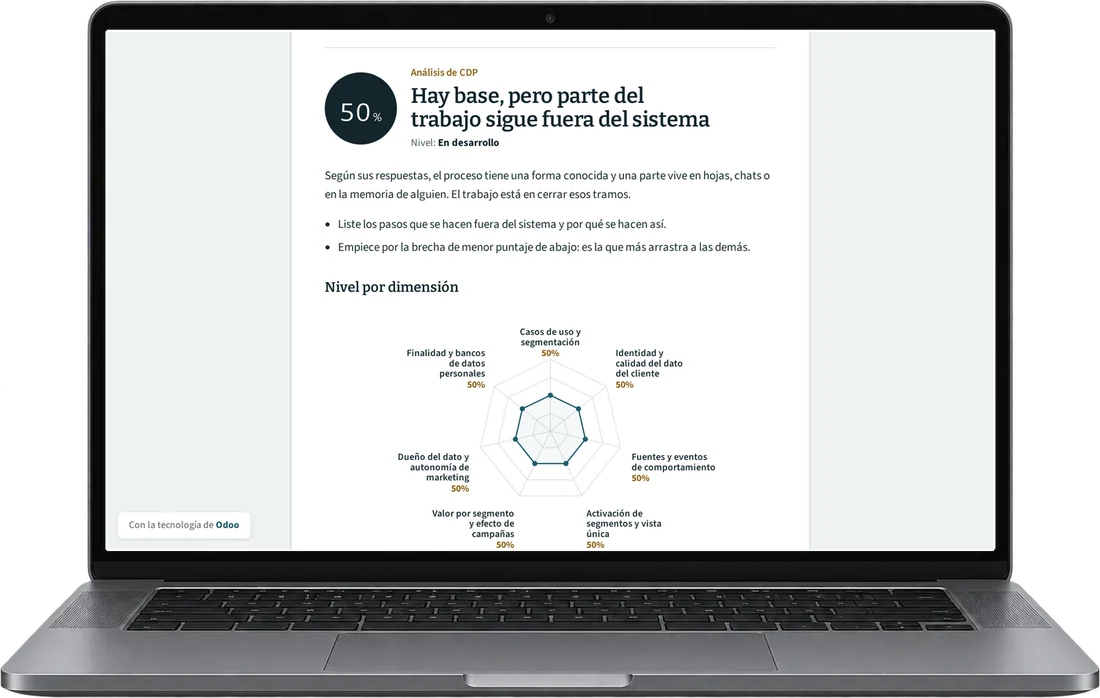
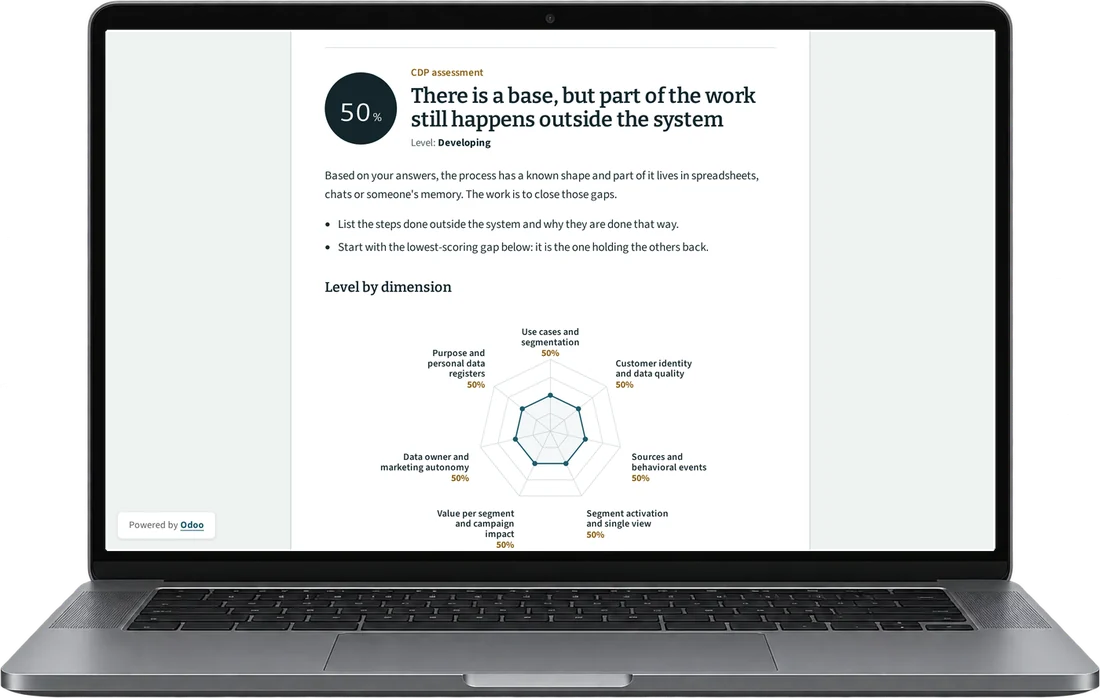
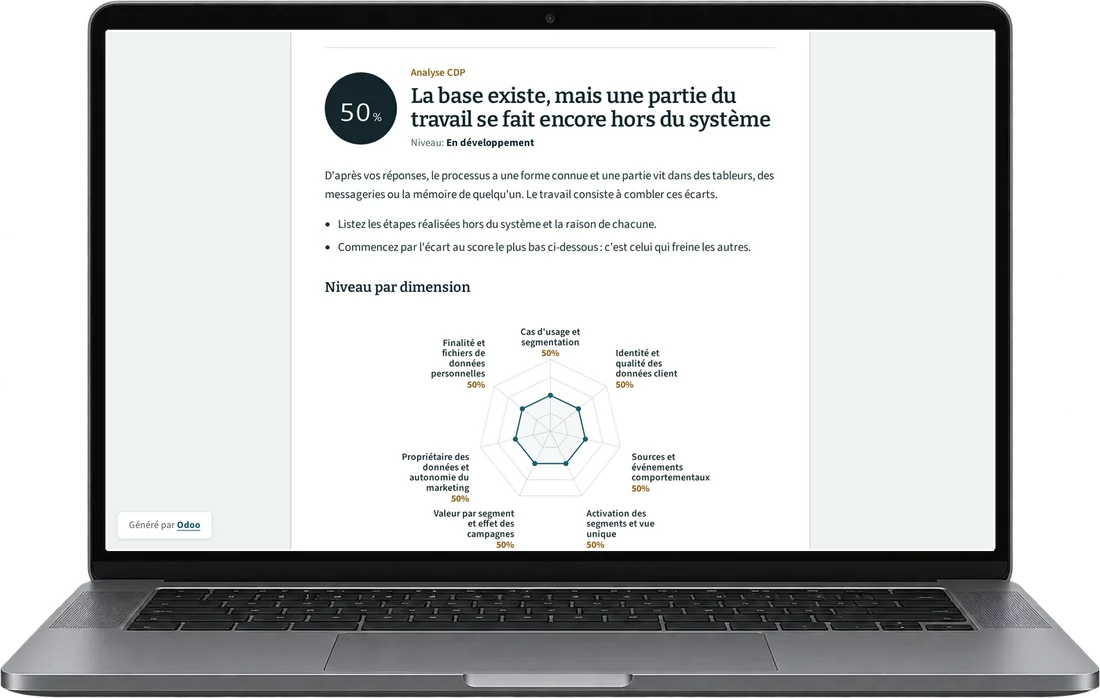
See the systemCDP assessment: 34 questions, 9 minutes
This analysis measures how customers are identified across till, web and app, and how those profiles become segments and campaigns. The questions describe observable situations in your operation, from loose lists to a unified profile with recorded purpose.
Scored dimensions
- Single customer profile. It checks whether purchases at the till, on the web, in the app and in the CRM are recognized as the same person through a validated ID number, email or mobile.
- Purchase and browsing sources. It checks which sources feed the profile: POS receipts, web orders, app events, abandoned carts and loyalty point redemptions.
- Use cases and segments. It checks whether each segment serves a written use case, such as replenishment repurchase, reactivation of lapsed buyers or cross-selling by category.
- Activation and measured effect. It checks how the segment reaches email, WhatsApp or ads, whether it excludes people who already bought, and whether repurchase is compared with a control group.
- Data owner and purpose. It checks who decides on customer data, whether each use has a valid purpose under Peru's Law 29733, and whether the data banks are registered with the ANPD.
What you receive
At the end you receive your level per dimension and the gaps across sources, identity, activation and data governance. You also receive the first action for each gap and criteria to choose between a CDP and your CRM with a data warehouse.
16 scored questions and 13 context questions (type of operation, size, current system). Context questions are not scored: they let us read the result against similar operations.
Free of charge. Only Diego Muñoz sees your answers.
Common questions about CDP
If your question is not listed, Diego answers it on WhatsApp during Lima business hours.
With few sources and thousands of customers, a well-run CRM and a data warehouse are usually enough. A CDP is justified by many sources, web behavior and activation across several channels.
We do not offer our own CDP implementation. We define use cases, sources and consent, help you choose and connect to your CRM and ERP.
Not as a product. Odoo joins sales, CRM, store and point of sale in one database, which covers some use cases; for the rest, specialized platforms are assessed.
The online assessment and the 30-minute review with Diego are free and carry no commitment.
Only Diego Muñoz sees them, to prepare the review. They are not shared with third parties or used for bulk mailings.
Review your case with Diego in 30 minutes
Diego Muñoz replies in person, on Lima time. If you have taken the assessment, he comes with your answers already read.
WhatsApp +51 919 488 260 · damunoz@dmunozgroup.com