Correct quotes the same day, with the margin in view
We analyze how you quote, write your configuration and discount rules, and help you choose between your ERP's quotations and a specialized CPQ.

36questions, 9 minutes and your result at the end
Signs your company needs one
- A quote for a configurable product takes days
- Discounts are given with no rule or approval
- Combinations are sold that cannot be built
- Price lists exist in several spreadsheet versions
- Approved quotes don't become orders automatically
- A quote's margin is known only after the sale
Company profile for CPQ, and when it is not a fit
Good fit
- You sell configurable products with options that are not always compatible.
- Each quote depends on the one person who knows the rules.
- Discounts are approved over chat and nobody compares quoted and actual margin.
Poor fit
- You sell a fixed-price catalog: ERP or CRM quotes are enough.
- Configuration rules are not written down: they get documented first.
- You quote a few times a month: maintaining the rules can cost more than it returns.

The cost of staying as you are
Sales that arrive late
While the quote waits for the expert, the customer receives others and decides on them.
Margin that slips away
Discounts with no matrix and out-of-date costs mean selling well and earning little.
Errors that reach production
An impossible combination sold is discovered on the shop floor, when the customer already expects a date.
CPQ analysis in four steps
Process and data first, the tool second. Each step ends in a deliverable you review.

Three real quotes
With your team we redo three recent quotes and note every rule, consultation and calculation done outside the system.
Rules and discount matrix
We write the compatibility rules and the discount matrix by role, validated by whoever decides today.
Fit-gap against options
We compare the rules with your ERP's quotations and with two or three specialized CPQs, using a demo script with your products.
Decision and connection
We deliver the decision matrix with three-year cost; with the chosen tool, we coordinate with the provider and connect it to your CRM and ERP.
Your company's inputs to the CPQ project
The list is confirmed at the first meeting and adjusted to your case.
Data
- Current price lists and discount rules
- Costs per product or option
- Recent won and lost quotes, as a sample
People
- The person who knows the configuration rules today
- An owner for discount approvals
Access
- Read access to the ERP: products, costs and orders
- Current quote and contract templates
CPQ assessment and selection
We assess and help you choose
Scope
We analyze your quoting process, write the configuration and pricing rules, and help you choose the tool, from Odoo Sales quotations to a specialized CPQ. We coordinate with the provider and connect the tool to your CRM and ERP; we do not offer our own implementation of a CPQ configurator.
Rules capture
Configuration, pricing and discount rules written and validated, even if you decide not to buy any tool.
Tool selection
Decision matrix between your ERP and specialized CPQs, with a demo on your products and three-year cost.
CRM and ERP integration
Coordination with the chosen provider and connection of the quote to the CRM, the order and production.
Market options for CPQ
In no order of preference. The choice comes from your requirements, your budget and the systems you already have.
Odoo Sales
Odoo Sales covers quote templates, optional products, variants, price lists, online signature and payment. For complex configuration rules it is assessed alongside specialized CPQs with the same criteria.
Other platforms we assess
- Salesforce Revenue Cloud (CPQ)
- Oracle CPQ
- SAP CPQ
- Conga CPQ
- DealHub
- Tacton
Selection criteria
- Number and complexity of your configuration rules
- Connection to your CRM, ERP and production
- Discount approvals by role
- License cost and the cost of maintaining rules
CPQ limits and ways to cover them
A CPQ does not invent compatibility rules
They are written with whoever configures today, before choosing the tool.
Loaded rules go stale without an owner
A rules and pricing owner is named, with a periodic review.
No in-house implementation of a CPQ platform
We define requirements, compare options and coordinate with the provider; we connect quoting to your ERP.
Connections between CPQ and other systems
Customer relationship management
The quote starts from the opportunity and reports back its status.
See the systemEnterprise resource planning
The accepted quote becomes an order.
See the systemProduct lifecycle management
Sellable options come from the current engineering product.
See the systemElectronic signature and digital certificates
The customer signs the exact version they accepted.
See the systemBusiness process management and workflow
Special discounts follow an approval workflow.
See the systemCPQ assessment: 36 questions, 9 minutes
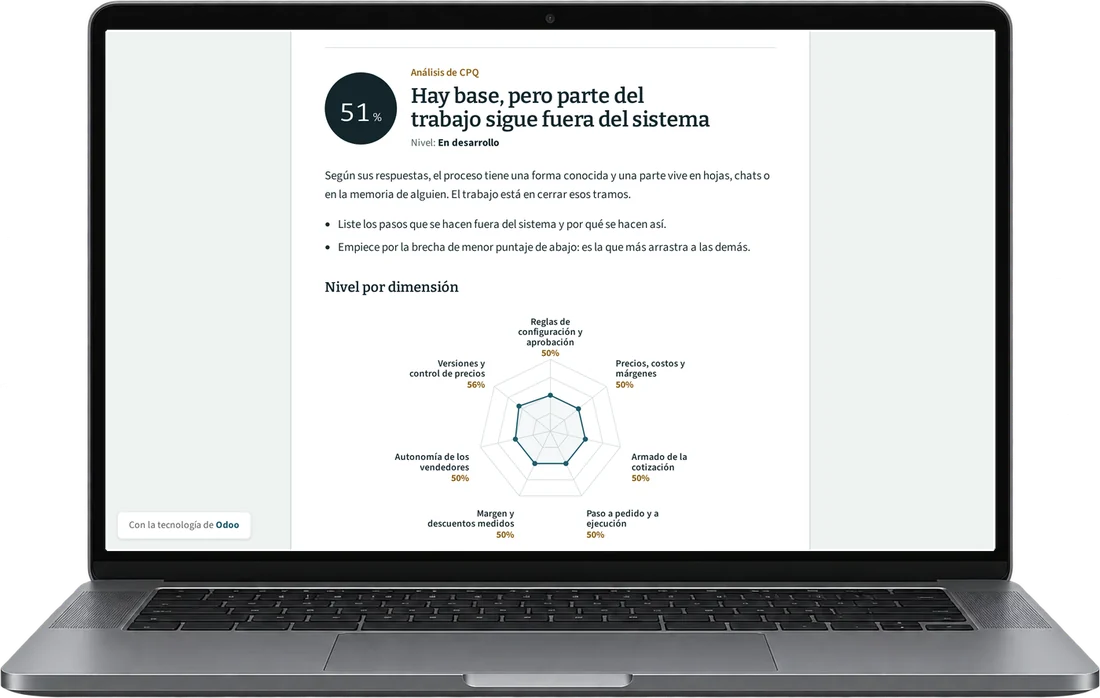
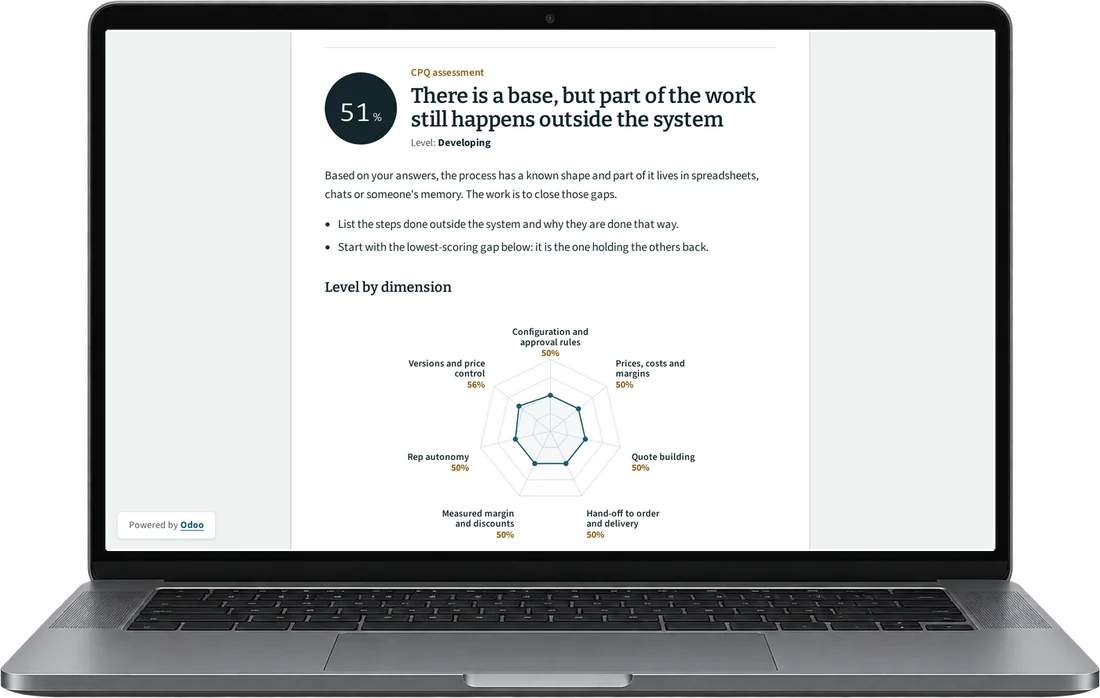
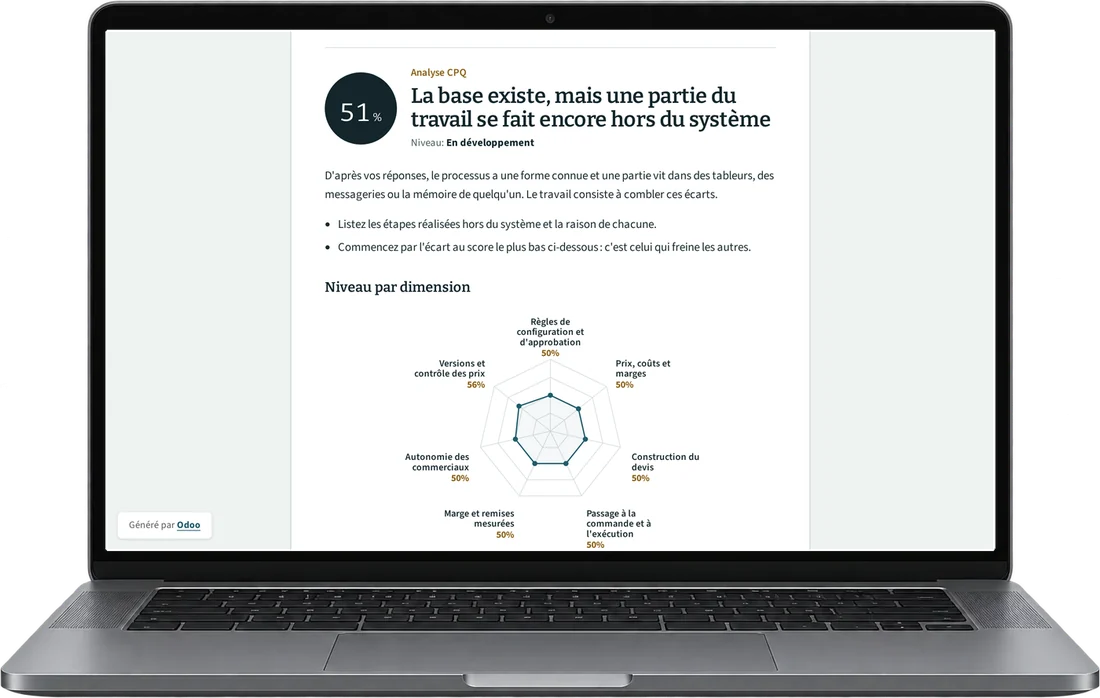
This assessment measures how your company configures, prices and approves quotes, and how they become orders. The questions cover compatibility rules, channel lists, tiers, discounts, availability and versions.
Scored dimensions
- Configuration rules. It checks whether compatibilities between products, options and accessories are written down, have an owner and are applied by the tool.
- Price lists and costs. It checks where price lists by channel and customer live, how they are updated with supplier cost and exchange rate, and who can change them.
- Discounts and quoted margin. It checks how special discounts are approved and whether discount per rep and quoted versus actual margin are measured.
- Quote building and turnaround. It checks where the quote is built, whether it shows availability by warehouse and whether preparation time is tracked.
- Order conversion and dispatch. It checks whether the accepted version becomes an order without retyping, reaches warehouse or supplier unchanged and respects price validity.
What you receive
At the end you receive your quoting process level and the gaps by dimension. Each gap names the first rule or data set to organize before choosing a tool.
17 scored questions and 14 context questions (type of operation, size, current system). Context questions are not scored: they let us read the result against similar operations.
Free of charge. Only Diego Muñoz sees your answers.
Common questions about CPQ
If your question is not listed, Diego answers it on WhatsApp during Lima business hours.
It depends on how many rules you have and how often they change. Many companies manage with ERP templates and price lists; the assessment tells you with your cases.
We do not implement third-party CPQ configurators. We write the rules, help you choose, coordinate with the provider and connect the tool to your CRM and ERP.
It is the best input. We read it with whoever built it and turn its formulas into written, tested rules.
The online assessment and the 30-minute review with Diego are free and carry no commitment.
Only Diego Muñoz sees them, to prepare the review. They are not shared with third parties or used for bulk mailings.
Review your case with Diego in 30 minutes
Diego Muñoz replies in person, on Lima time. If you have taken the assessment, he comes with your answers already read.
WhatsApp +51 919 488 260 · damunoz@dmunozgroup.com