- Home
- Systems
- Supply chain
- SRM
Qualified suppliers, valid documents and data-based evaluation
An SRM (supplier relationship management) system registers, qualifies and evaluates suppliers, and gives them a portal to check orders and payments. Diego analyses your process, helps you choose the tool and connects it to your ERP.
37 questions · result by dimension · free
One register for everything you know about each supplier
An SRM brings together on each supplier's record its details, documents with expiry dates, qualification, delivery and quality performance, and the queries that arrive by email today.
Without it, purchasing keeps evaluations and certificates in separate files and finds out about an expired document at the audit.
- 01Onboarding and qualification
- 02Performance evaluation
- 03Supplier portal
- 04Supplier contracts
Processes it covers
Indicators that call for a SRM
These signs usually share one origin: each supplier's information is spread across emails, folders and the ERP master.
- There is no single register of qualified suppliers
- Certificates, powers of attorney and insurance expire without warning
- Supplier evaluation is a yearly opinion
- Suppliers ask about their payments by email
- Delivery and quality performance is not measured by supplier
- Inputs that depend on a single supplier are not identified

Company profile for a SRM, and when it is not a fit
Good fit
- Companies with hundreds of active suppliers and several purchasing categories
- Sectors where customers or regulators audit suppliers: mining, food, pharma, energy
- Central purchasing teams negotiating annual contracts that need performance data
Poor fit
- A few dozen suppliers with recurring purchases: the ERP's master and portal are enough
- Companies without purchase orders in the system: the purchasing flow comes first
- A problem limited to payment status enquiries: the ERP portal or a payment advice solves it
Cost of suppliers without qualification or evaluation
Audits with findings
An expired certificate or a qualification with no evidence becomes an audit or customer finding.
Negotiating without data
Without measured performance, the conversation with the supplier rests on each buyer's impressions.
Exposed payments
A bank account change accepted by email is a known fraud route.
SRM analysis method
The assessment follows a supplier's life in your company: onboarding, qualification, documents with expiry dates, orders, performance evaluation and risk.
Online assessment
37 questions on qualification, records, documents, portal, evaluation and risk. The result shows whether the weak point is onboarding or follow-up.
30-minute review
Diego reviews the result with you and asks for the supplier onboarding form you use today and your ten highest-spend suppliers. From that he proposes where to start.
Supplier qualification workshop
Half a day with purchasing, quality and treasury: qualification criteria by category, required documents and their validity, evaluation indicators and bank account validation.
Selection and integration
Comparison of two to four options, from your ERP's portal to an SRM platform, using your categories and supplier count, and connection to the ERP master and payments.
Dimensions of the SRM assessment
Onboarding and qualification
Example: How is a new supplier onboarded?
Supplier master
Example: Is there one register of suppliers?
Documents and portal
Example: Where are each supplier's documents kept (powers of attorney, certificates, insurance, contracts)?
Integration with purchasing and payments
Example: Does supplier evaluation use receiving and quality data from the system?
Performance evaluation
Example: Do you measure each supplier's delivery performance?
Purchasing team and suppliers
Example: Where do authorised buyers look up each supplier's current terms?
Risk and compliance
Example: Do you check suppliers' tax and legal status (RUC status, registered address, restricted lists)?
Your company's inputs to a SRM project
Data
- ERP supplier master with tax ID (RUC), contacts and bank accounts
- Documents currently required from a supplier and where they are stored
- Last year's orders, receipts and rejections
People
- Purchasing or procurement manager
- One representative from quality and one from treasury
Access and documents
- Read-only ERP user for purchasing and payments
- Sample of current onboarding forms and evaluations
Diego's services in a SRM project
Qualification criteria
With purchasing and quality we define which documents and data each supplier category must provide and how often they are renewed.
Deliverable: qualification matrix by category
Evaluation model
We choose delivery, quality and service indicators the ERP already records and set how they are calculated and how often they are reviewed.
Deliverable: evaluation sheet with the formula and source of each indicator
Selection and integration
We compare your ERP's portal with SRM platforms and connect the chosen one to the supplier master, receipts and payments.
Deliverable: single supplier master synchronised with the ERP
First qualifications on the platform
We qualify the first suppliers of one category on the platform and check that each expiring document triggers its alert and blocks the purchase order.
Deliverable: acceptance tests with real suppliers
Scope
Dmunoz Group does not implement SRM platforms: the vendor configures them. Diego works on your company's side in the analysis, the choice, the ERP integration and checking the result.
Platforms we compare for a SRM
Odoo
Odoo Purchase with supplier portal and basic evaluation. It fits when the ERP is already Odoo and the scope is register, documents and order and payment queries.
Other recognised platforms
- SAP Ariba Supplier Management
- Coupa Supplier Management
- Jaggaer
- Ivalua
- GEP SMART
Comparison criteria
- Onboarding form with mandatory documents by category and expiry alerts
- Evaluation calculated from ERP deliveries and rejections, not from one-off surveys
- Portal where the supplier updates its data and checks orders, invoices and payments
- Control of bank account changes with validation before payment
The order of the list implies no preference. The choice of an SRM comes from your qualification matrix and the number of active suppliers per category.
Systems a SRM exchanges data with
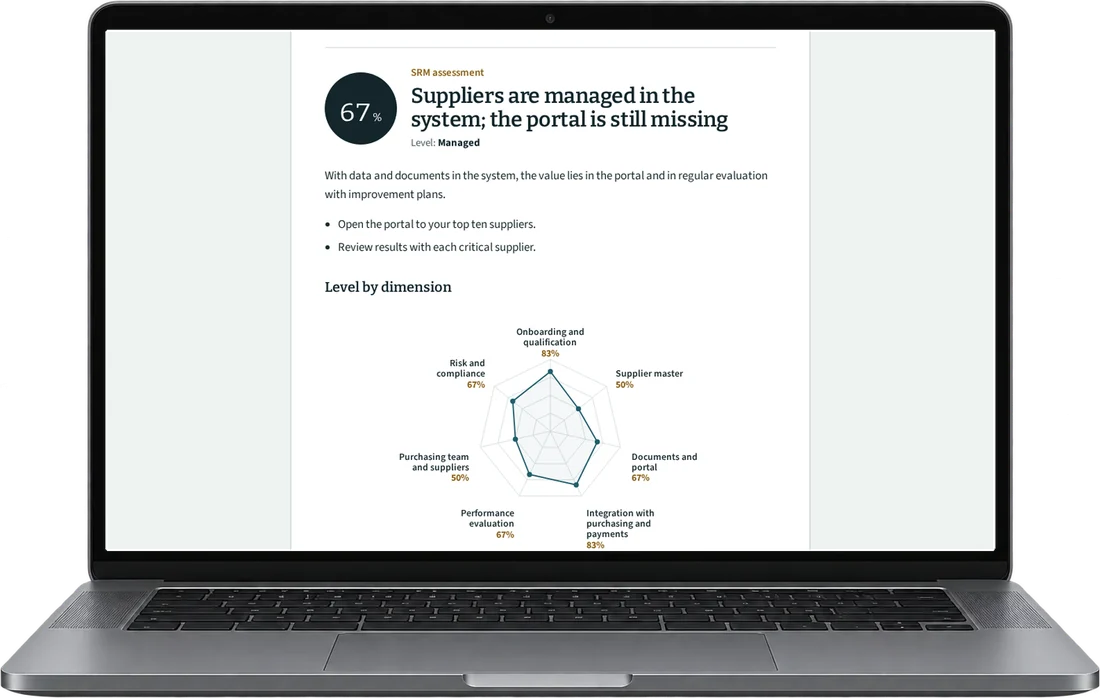
SRM assessment result in 37 questions
This assessment measures how your company registers, qualifies, evaluates and pays manufacturers, importers and carriers. The questions describe where each supplier's documents, terms and delivery data are kept.
Scored dimensions
- Onboarding and qualification. It observes whether each supplier or carrier is onboarded with a validated tax ID, mandatory documents and qualification criteria by category, with recorded approval.
- Master, categories and terms. It observes whether there is a single supplier master with an owner for changes, classified by category and criticality, and whether current commercial terms are visible to buyers.
- Supplier portal and documents. It observes whether each supplier's documents are on its record with an expiry date and whether the supplier checks orders, invoices and payments through a common channel.
- Delivery and quality performance. It observes whether evaluation uses receiving data, such as complete and on-time deliveries, rejections and discrepancies, and whether failures trigger tracked actions.
- Tax and dependency risk. It observes whether the tax ID status with SUNAT is checked, whether bank account changes are verified through another channel and whether brands or supplies that depend on a single supplier are known.
What you receive
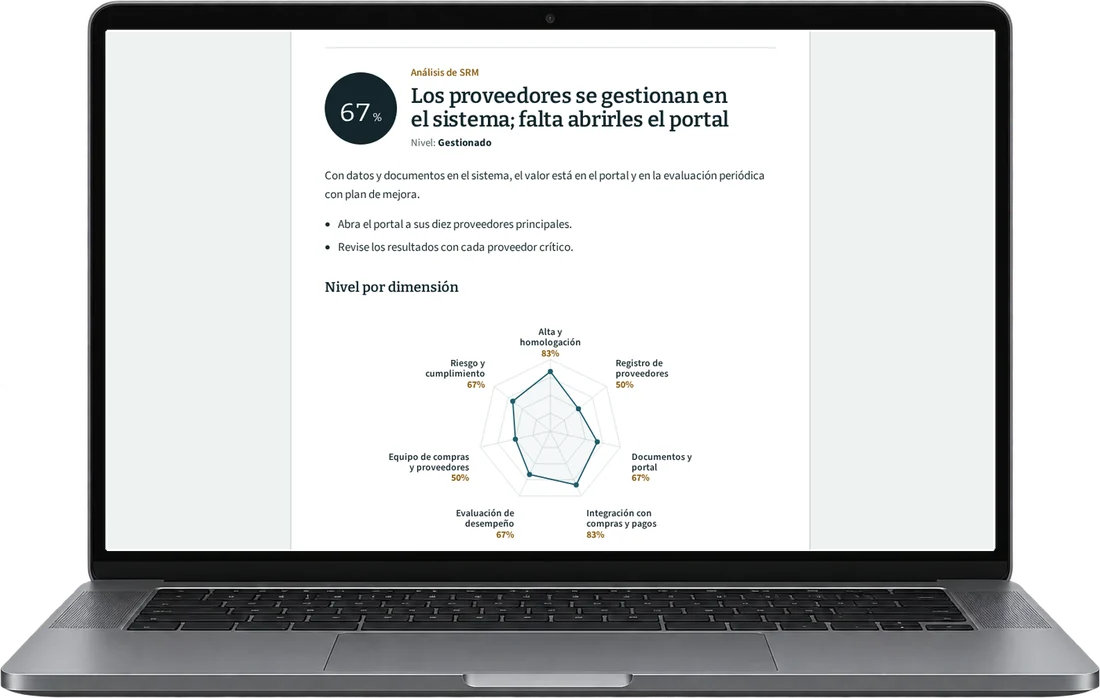
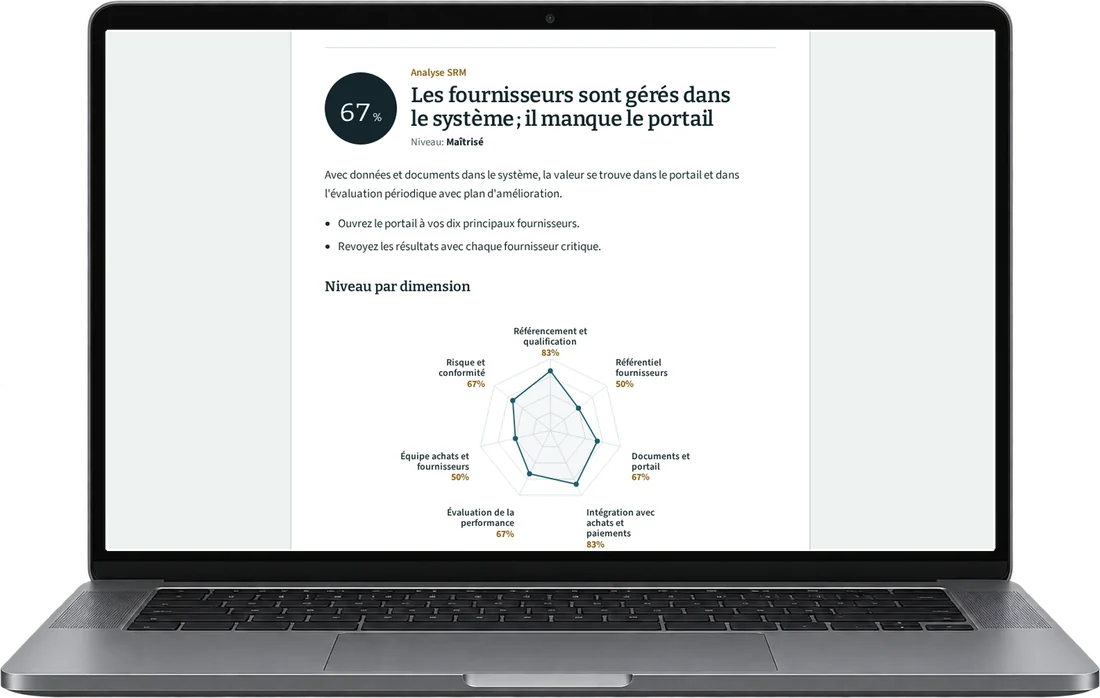
When you finish you receive your level in five supplier management dimensions and the gap in each. Each gap comes with a concrete action for your master, portal or evaluation.
18 scored questions and 14 context questions (type of operation, size, current system). Context questions are not scored: they let us read the result against similar operations.
Common questions about a SRM project
With dozens of suppliers, completing your ERP master and portal is often enough. With hundreds of suppliers, critical categories or customer audits, an SRM platform is worth assessing. The assessment shows which case is yours.
The portal opens first to the main suppliers and for the most frequent queries, such as payment status. The rest stay on email until usage holds.
An SRM platform is implemented by its vendor. Diego defines qualification and evaluation criteria with you, compares options and connects the tool to your ERP.
The online SRM assessment and the 30-minute review are free. If a workshop or a project makes sense afterwards, you get a proposal with scope and deliverables before deciding.
Only Diego Muñoz sees your answers on supplier onboarding, evaluation and valid documents, to prepare the review. They are not shared with third parties or used for bulk mailings.
A 30-minute SRM review with Diego
Take the assessment and book the review with the list of your ten highest-spend suppliers. Diego Muñoz replies in person, on Lima time.
WhatsApp +51 919 488 260 · damunoz@dmunozgroup.com