- Home
- Systems
- Supply chain
- TMS
Routes built on criteria and every delivery confirmed the same day
A TMS (transportation management system) plans routes, assigns vehicles or carriers, tracks deliveries and checks freight. Diego analyses your deliveries, helps you choose the tool and connects it to your ERP.
37 questions · result by dimension · free

From shipped order to signed delivery
A TMS takes orders ready to ship, builds routes around time windows and capacity, gives the driver an app to record each stop and matches trips against each carrier's rate.
Without it, the dispatcher builds routes in spreadsheets and the company only knows what was delivered when the driver returns.
- 01Route planning
- 02Carrier assignment
- 03Delivery tracking
- 04Proof of delivery
- 05Freight settlement
Processes it covers
Indicators that call for a TMS
These signs tend to appear together when routes live in a spreadsheet and a delivery is only confirmed when the driver returns.
- Delivery routes are built by hand every day
- You don't know which deliveries were made until the driver returns
- Freight cost per customer or order is unknown
- Carrier invoices are paid without matching them to deliveries
- Delivery notes go out with wrong ubigeo codes or plates
- There is no proof of delivery with signature or photo

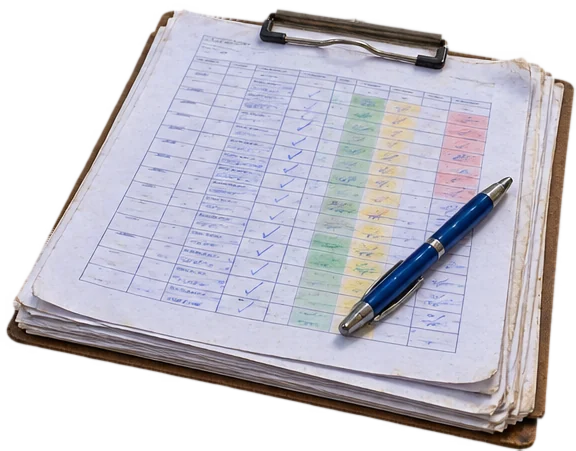
Company profile for a TMS, and when it is not a fit
Good fit
- Distributors with daily urban deliveries and many stops per vehicle
- Companies hiring several carriers that want to check every freight invoice
- Operations whose customers require a time window or signed proof of delivery
Poor fit
- A few deliveries a week with one vehicle: a schedule and the ERP delivery note are enough
- Shipments fully handled by a logistics provider with its own system: integrating with its reports fits better
- Customer bases without clean addresses: customers are geocoded first, then a tool is chosen
Cost of deliveries without planned routes or checked freight
Extra kilometres
A route built from memory repeats streets and leaves deliveries outside their time window.
Failed deliveries
Each failed delivery costs the wasted trip and the next one, and the customer notices before the company does.
Unchecked freight
Without a rate card or recorded trips, the carrier invoice is paid as it arrives.
TMS analysis method
The assessment follows an order from the moment it is ready in the warehouse until the carrier invoices it: route, assignment, tracking, proof of delivery and freight settlement.
Online assessment
37 questions on routes, addresses, rates, tracking and the delivery note. The result shows whether the weak point is planning or freight control.
30-minute review
Diego reviews the result with you and asks for the route sheet of a typical day and one carrier invoice. From that he tells whether a routing tool is enough or a TMS is needed.
Delivery and freight workshop
Half a day with dispatch, drivers and whoever pays freight: customer time windows, capacity per vehicle, rates per carrier and delivery note data.
Selection and integration
Comparison of two to four routing tools or TMS using a real day of orders, and connection of the chosen one to your ERP for orders, delivery notes and freight cost.
Dimensions of the TMS assessment
Route planning
Example: How are the day's delivery routes built?
Addresses and rates
Example: How are delivery point locations validated?
Tracking and proof of delivery
Example: How is the status of each delivery recorded during the route?
Integration with warehouse and delivery note
Example: How do orders ready to ship reach whoever plans the routes?
On-time delivery and freight cost
Example: Do you measure the share of deliveries on time and within the requested window?
Drivers and dispatch
Example: How many people know how to schedule routes?
Freight and exception control
Example: How are carrier invoices checked?
Your company's inputs to a TMS project
Data
- Customer addresses with district, landmark and, if available, coordinates
- Available fleet with weight and volume capacity
- Current rate card of each carrier
People
- Dispatch lead or transport manager
- One or two drivers to test the app
Access and documents
- Export of a typical day's orders from the ERP
- One month's freight invoices and issued delivery notes
Diego's services in a TMS project
Delivery survey
We measure one dispatch day with you: orders, zones, vehicles, time windows and failed deliveries with their cause.
Deliverable: current delivery map and prioritised routing requirements
Routing tool or TMS selection
We ask each vendor to plan the same day of orders and compare routes, kilometres, driver app and three-year cost.
Deliverable: decision matrix with the outcome of each demo
ERP and delivery note integration
We connect orders and addresses going out and proof of delivery and freight cost coming back to the ERP, with the delivery note issued from route data.
Deliverable: order, route, delivery note and delivery flow without retyping
First week of live routes
During the first week we compare each planned route with the GPS track and each freight invoice with the rate loaded in the TMS.
Deliverable: acceptance tests with real routes and freight
Scope
Dmunoz Group does not implement TMS platforms: the vendor configures them. Diego works on your company's side in the analysis, the choice, the ERP integration and checking the result.
Platforms we compare for a TMS
Odoo
Odoo Inventory with shipping methods and carrier connectors. It covers part of a TMS scope; routing and the driver app usually come from a separate tool.
Other recognised platforms
- Oracle Transportation Management
- SAP Transportation Management
- Blue Yonder TMS
- Beetrack (DispatchTrack)
- SimpliRoute
- Descartes
Comparison criteria
- Routing with time windows, weight and volume capacity and several depots, tested on a real day of orders
- Driver app with proof of delivery by signature, photo and location, also offline
- Rates per carrier and matching of the freight invoice against trips
- Electronic delivery note issued from the ERP with the plate and driver of the route
The order of the list implies no preference. The choice of a TMS comes from planning the same day of orders on each platform.
Systems a TMS exchanges data with
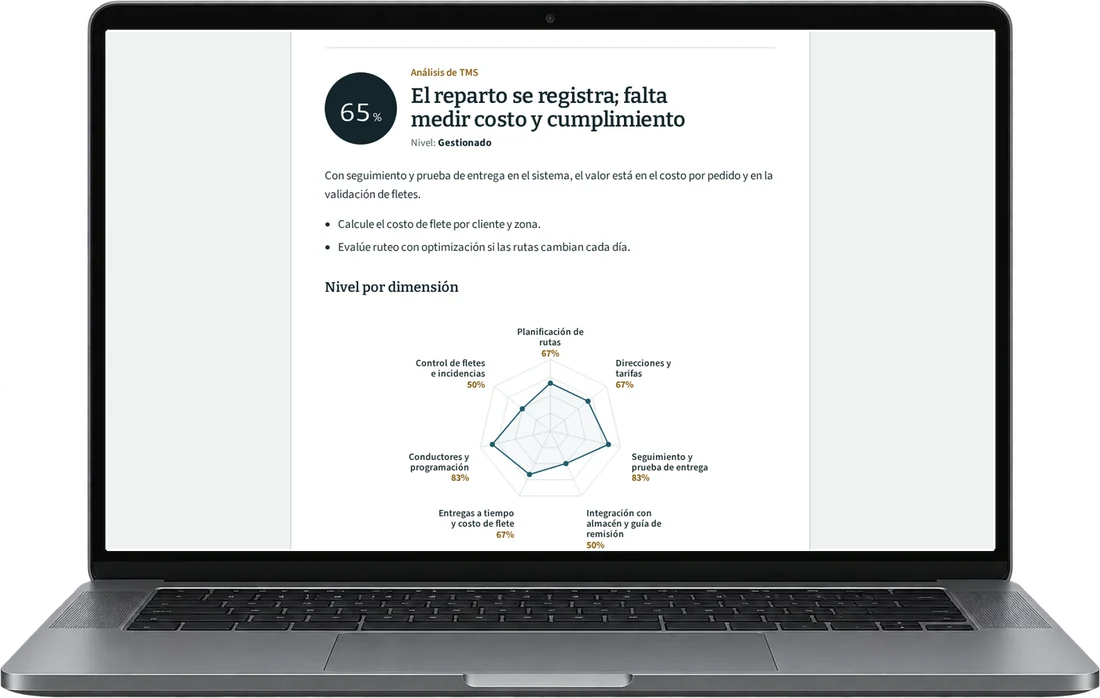
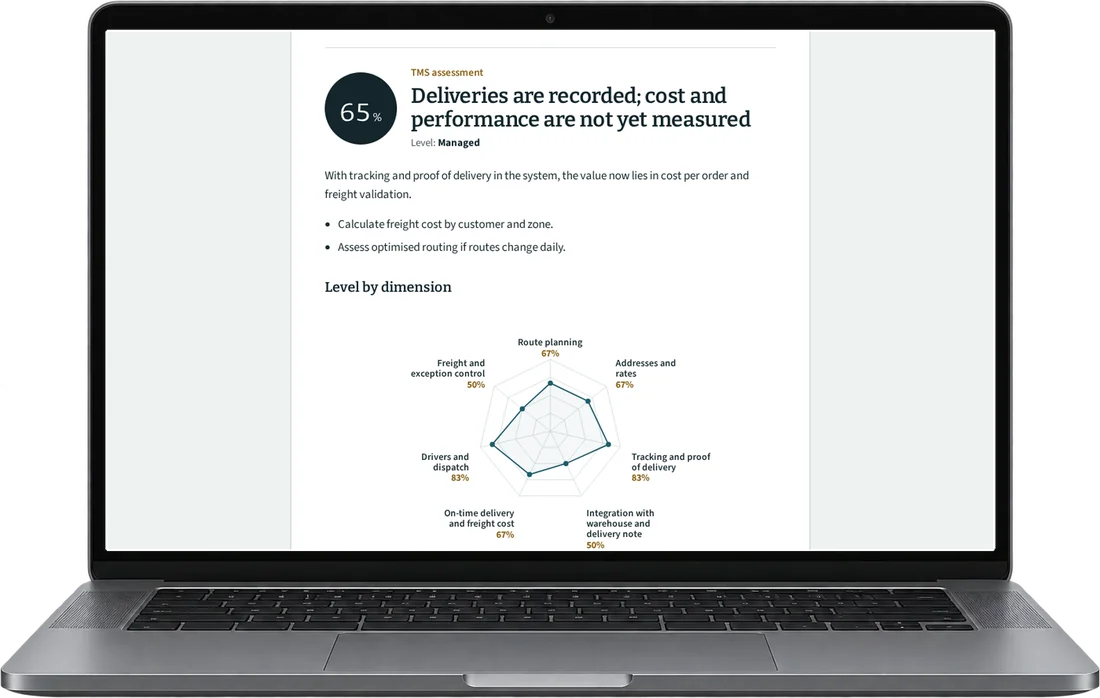
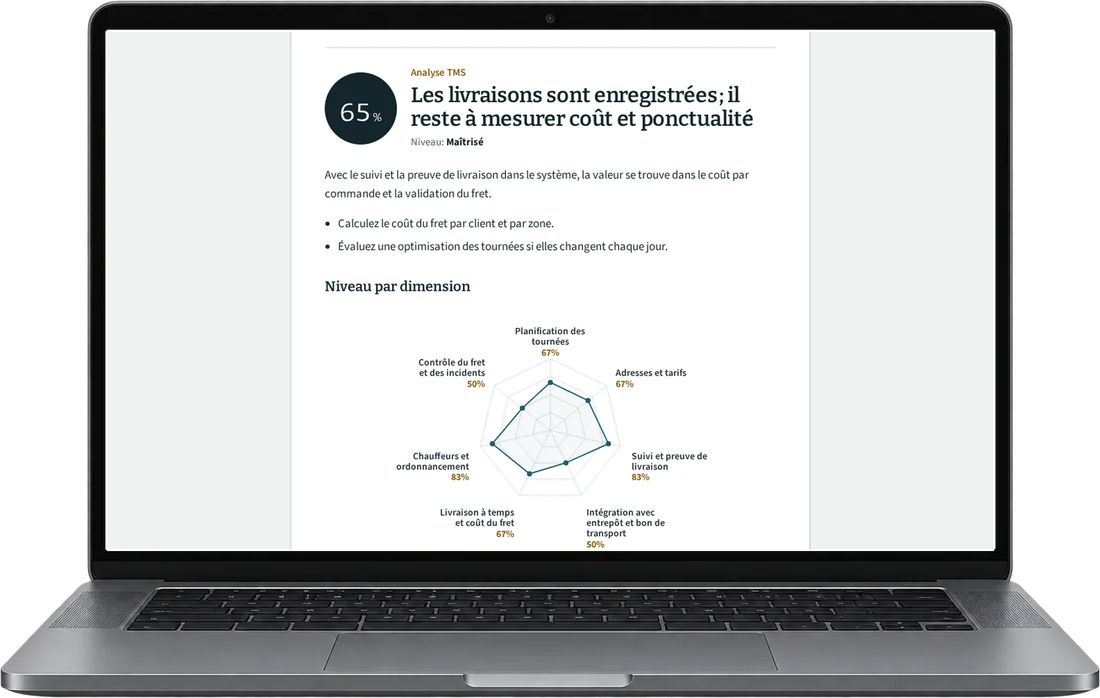
TMS assessment result in 37 questions
This self-assessment evaluates how your operation consolidates orders, schedules vehicles, tracks deliveries and settles freight charges. It uses questions about actual routes, capacity, transport documents, delivery evidence, costs and delivery exceptions.
Scored dimensions
- Routing and capacity. Assesses how orders are consolidated, vehicles are assigned and route feasibility is checked before dispatch.
- Addresses and freight rates. Checks delivery location quality and the validity of freight rates by carrier, area and vehicle.
- Tracking and delivery. Examines how each stop's status is updated and how verifiable proof of delivery is captured.
- Orders and shipping documents. Verifies data continuity between warehouse-released orders, confirmed routes and electronic transport documents.
- Service and transport cost. Determines whether delivery-window compliance, freight cost per order and capacity utilization are measured.
- Exceptions and settlement. Examines failed-delivery handling, scheduling continuity and freight reconciliation before payment.
What you receive
Upon completion, you receive a transport maturity level and a breakdown of gaps in planning, data, execution, documentation, performance and settlement. The result identifies actions to review the process, define the scope of a TMS or routing tool and assess integration with the ERP, WMS and electronic transport documents.
18 scored questions and 14 context questions (type of operation, size, current system). Context questions are not scored: they let us read the result against similar operations.
Common questions about a TMS project
With your own fleet and urban deliveries, a routing tool with a driver app is often enough. With several carriers, freight tenders or intercity loads, a TMS makes sense. The assessment shows which case is yours.
The delivery note must carry the right plate, driver, origin and destination. Diego connects the assigned route to issuance from the ERP so that data is not typed twice.
The vendor configures it. Diego defines requirements with you, compares options using your data, connects the tool to your ERP and checks the agreed flow is followed at go-live.
The online TMS assessment and the 30-minute review are free. If a workshop or a project makes sense afterwards, you get a proposal with scope and deliverables before deciding.
Only Diego Muñoz sees your answers on routes, carrier rates and proof of delivery, to prepare the review. They are not shared with third parties or used for bulk mailings.
A 30-minute TMS review with Diego
Take the assessment and book the review with a typical day's route sheet. Diego Muñoz replies in person, on Lima time.
WhatsApp +51 919 488 260 · damunoz@dmunozgroup.com