Safety records up to date and actions that get closed
An EHS system manages incidents, inspections, work permits, risk matrices and environmental obligations. We analyse your OHS management and help you choose.
35 questions: incidents and investigation, hazards and risks (IPERC) and 4 more topics

Safety, health and environment with evidence
An environment, health and safety (EHS) system records incidents and their investigation, the hazard and risk matrix, inspections, work permits and mandatory training.
In Peru it organises the records required by Law 29783 and its regulations, and keeps evidence ready for an inspection.
Processes it covers
- Incident management
- Inspections
- Work permits
- Risk matrix
- Mandatory training
- Environmental reporting
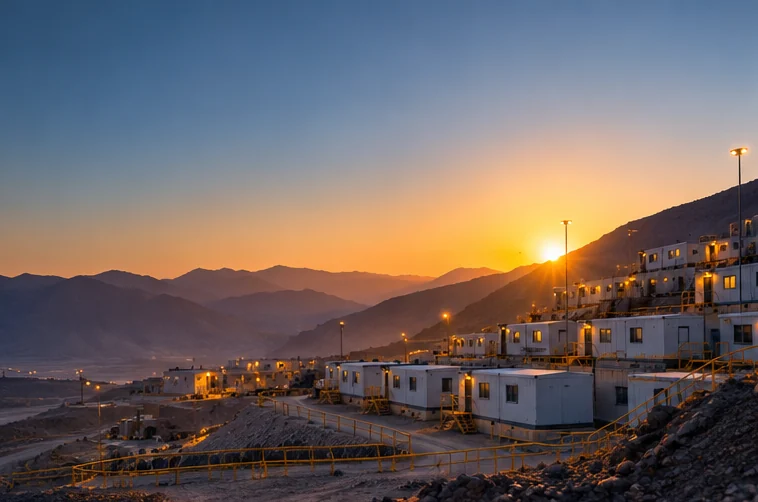
Companies that need an EHS system, and cases where another option fits better
Who it is for
- Companies subject to Law 29783 with staff in plants, sites, mines or the field
- OHS managers who keep the IPERC matrix, incidents and inspections in spreadsheets and folders
- Companies with contractors whose staff, induction and PPE must be checked before entry
When it is not the right fit
- If the OHS management system is not designed yet (policy, IPERC, committee), that design comes first
- If the only requirement is keeping the records with few workers, the Ministry of Labour reference formats may be enough
Signs it is time to assess an EHS system
- Incidents are reported on WhatsApp and not investigated methodically
- Hazard and risk matrices are not updated when the process changes
- Mandatory OHS training is tracked in a spreadsheet
- A labour inspection (SUNAFIL) means hunting for records in several folders
- High-risk work permits are signed on paper
- Environmental reports are prepared by hand every period
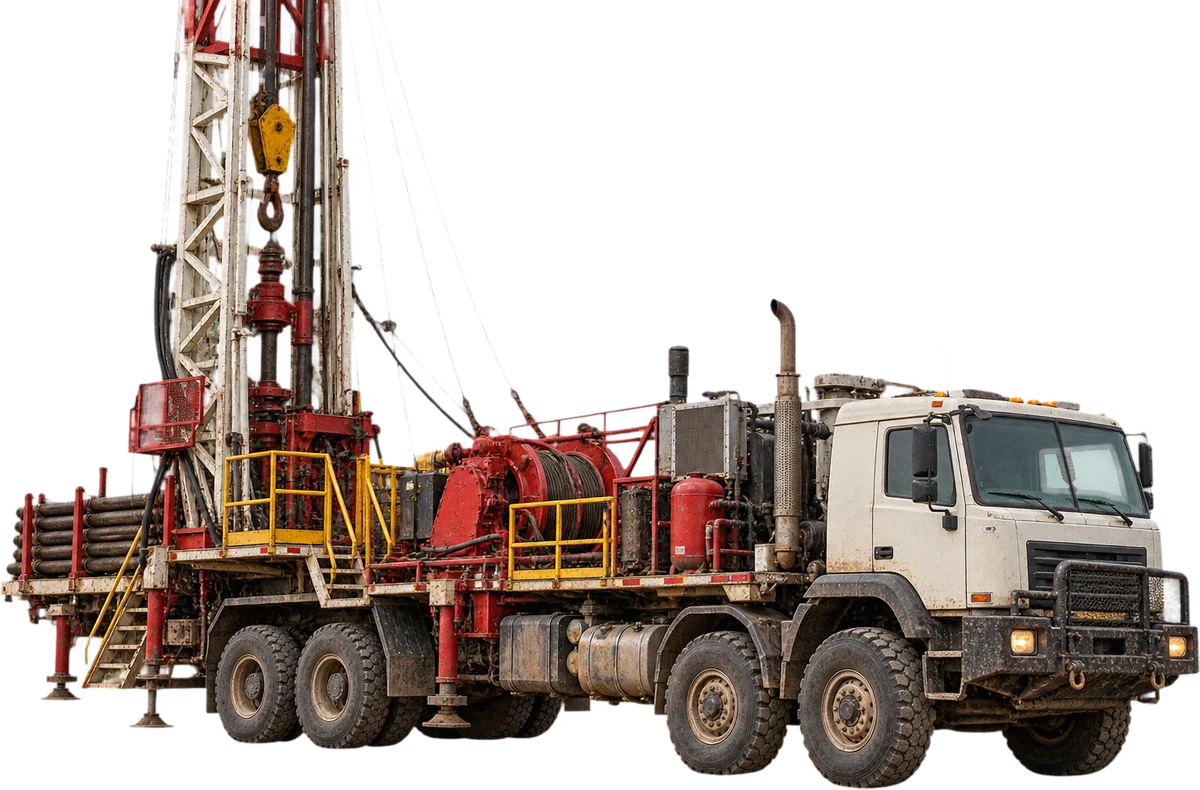
The cost of safety in binders
Incidents that recur
An incident reported on WhatsApp and never investigated happens again.
Difficult inspections
Gathering scattered records for SUNAFIL takes days and leaves gaps that can end in a fine.
Staff without current training
If training and staff live in separate sheets, people enter the plant with expired training.
From the reported incident to a controlled risk
Online assessment
35 questions on occupational health and safety management. When you finish you see your level by dimension.
30-minute review
Diego reviews with you how the IPERC matrix is updated, how long investigation actions take to close and which mandatory records are up to date.
OHS workshop
With your OHS officer we review the incident cycle, the hazard and risk matrix, high-risk permits and mandatory records.
Selection and integration
We compare 2 to 4 options against your operation and Law 29783, and define the integration with HR and maintenance.

Data, master records and access your company provides for an EHS system
- Current IPERC matrix by area and job
- Mandatory records for recent months: accidents, incidents, inspections, training, PPE
- Annual OHS programme and committee or supervisor minutes
- Roster of workers and contractors with job and area
- Field connectivity conditions for recording from mobile phones
Deliverables of the EHS/SST analysis, selection and integration
IPERC matrix as data
Hazards, risks, controls and residual risk per job, with the rule for review when a process changes or after an incident.
Structured and approved matrix
Incident-to-action flow
Field report, classification, investigation, actions with owner and deadline, and notification when required.
Procedure approved by OHS
Mandatory records map
Each record required by the rules with its source in the system, owner and frequency.
Compliance matrix
Selection and integration
EHS platforms compared on offline mobile use, and the link with payroll for staff and the ERP for PPE.
Decision matrix and integration map
Typical risks of a EHS/SST project and how they are controlled
A system nobody uses in the field
ControlIncident report in a few taps and offline, tested with field supervisors.
IPERC copied from another area
ControlEach area validates its matrix with the people doing the work before it is loaded.
Corrective actions never closed
ControlA deadline per action and a review of overdue ones at every committee session.
Scope limits and market options for EHS/SST
Limits
- We do not implement the chosen EHS platform; the vendor or its integrator does
- We do not replace the OHS specialist or the occupational physician: the system records what they decide
- Legal interpretation of a specific case comes from a labour lawyer
Selection criteria
- Records required by Law 29783
- Mobile app for field reports and inspections
- Work permits with checks and approval
- Integration with HR and training
Other platforms on the market
- Intelex
- Cority
- Enablon (Wolters Kluwer)
- Sphera
- VelocityEHS
- SAP EHS
In no order of preference.
Law 29783 and mandatory records
- Records under Law 29783 and its regulation (D.S. 005-2012-TR), with the reference formats of R.M. 050-2013-TR: accidents, incidents, occupational diseases, medical exams, agent monitoring, inspections, training, emergency equipment and audits
- IPERC matrix per job and its review when working conditions change
- Accident notification to the Ministry of Labour and evidence for SUNAFIL inspections
- In mining, the additional requirements of D.S. 024-2016-EM
Systems that exchange data with an EHS system
Human capital management
staff, jobs and medical checks
See the systemLMSLearning management system
mandatory training
See the systemQMSQuality management system
shared findings and actions
See the systemEAM/CMMSEnterprise asset management / maintenance management
equipment lockouts and permits
See the systemDMS/ECMDocument and enterprise content management
controlled procedures and records
See the systemMine FMSMine fleet dispatch and heavy equipment maintenance
equipment and staff in operation
See the systemEHS/SST assessment in 9 minutes
This assessment measures how your operation manages occupational health and safety for own staff and contractors. The questions cover incidents, hazard matrix and JSA, work permits, accreditation, mandatory records, inspections and PPE.
Scored dimensions
- Incident reporting and investigation. Whether accidents, dangerous incidents and substandard acts or conditions are reported during the shift, investigated with a method and their actions closed in the field.
- Hazard matrix, JSA and exposure agents. Whether the baseline and continuous hazard matrices are up to date by area and task, whether the JSA is filled in the field before starting, and whether exposure monitoring updates controls.
- High-risk work permits. Whether work at height, hot work, confined space entry, lifting or work on energized equipment starts only with a field-verified permit, recorded lockout and signed closure.
- Training, medical fitness and accreditation. Whether each worker, own or contractor, has induction, task training, occupational medical exam and SCTR insurance current before entering the work area.
- Mandatory records, committee and rates. Whether records required by Law 29783 and sector regulations are complete, whether the committee reviews data monthly and whether rates use labor hours of own staff and contractors.
- Field inspections and PPE. Whether the inspection program for work areas and equipment is met, whether its findings generate actions and whether each worker has the PPE their task requires.
What you receive
At the end you receive your level in each OHS management dimension. Each gap comes with a first action the safety team can verify in the field; it does not replace the OHS officer's judgment or legal advice.
19 scored questions and 11 context questions (type of operation, size, current system). Context questions are not scored: they let us read the result against similar operations.
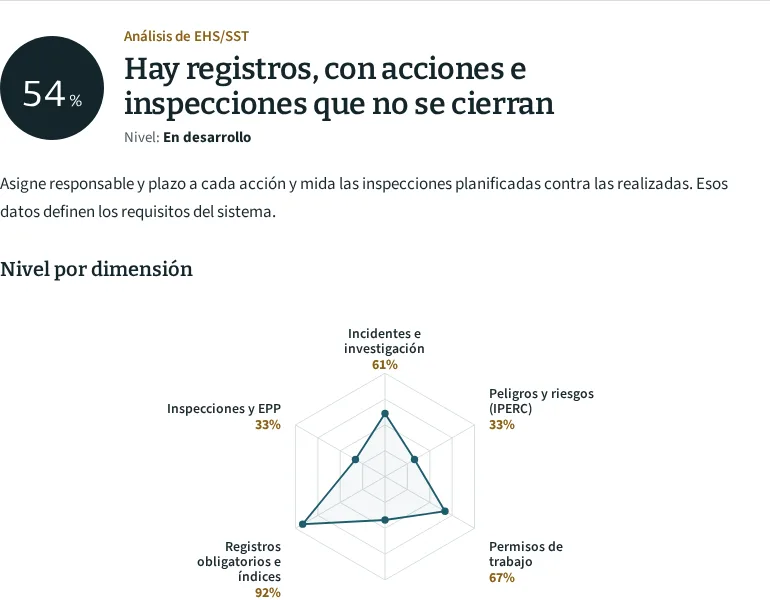
35 questions, 9 minutes
Example: if work permits are filled in but not closed, the result flags Work permits and proposes starting with high-risk work.
Answers about EHS/SST
They are names for the same field: safety, occupational health and environment. In Peru, SST refers to the labour part regulated by Law 29783.
We do not replace your OHS officer or give legal advice. We analyse the process, help you choose the tool and connect it with your systems.
Reports and inspections happen in the field, so a mobile app that works offline and syncs later is worth having.
Review your EHS/SST result with Diego
Twenty minutes by video call or WhatsApp. Have at hand one area’s IPERC matrix and this year’s incident log.
Assessment first: the review uses your answers.