- Home
- Systems
- People
- Learning management system
Training with records, assessment and certificates for each person
Before you choose a learning platform, Diego organises the annual plan, onboarding and mandatory courses with you. Then he helps you choose it and connects it to your staff records.
Online assessment of staff training: 38 questions, results by dimension when you finish, free of charge.
What an LMS is and what it solves
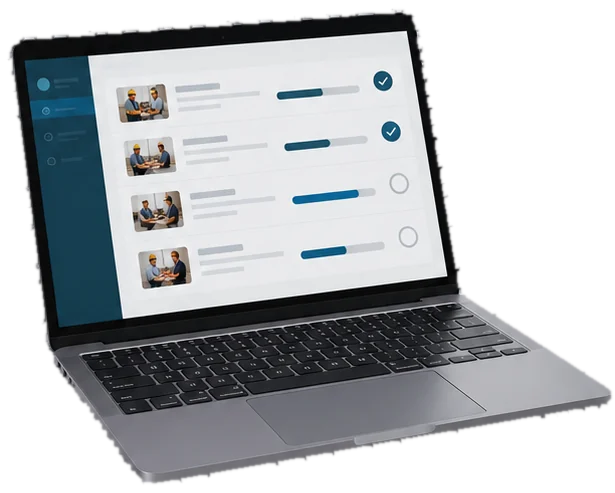
An LMS (learning management system) publishes courses, tracks enrolment and progress, assesses learners and certifies mandatory and onboarding training.
It solves a concrete problem: material is sent around by email and nobody has a consolidated record of who completed which training.
Processes it covers
Signs your company needs an LMS
If three or more happen in your training team, the assessment shows whether to start with the plan, the records or assessment.
- Onboarding changes depending on who delivers it
- There is no record of completed training
- Safety training is tracked in a spreadsheet
- Each department keeps its slides and videos in its own folder
- Courses end with an attendance sheet and no assessment
- Nobody knows which high-risk work qualifications expire next month
Who an LMS is for and when it does not fit
Who it is for
- Companies with mandatory occupational health and safety training
- Operations with frequent hires that need the same onboarding for everyone
- Teams that prepare audits by hunting for attendance sheets
- Companies with staff across several sites or in the field
When it does not fit
- If training sessions are few and in person, an orderly register with certificates may be enough.
- Without an annual plan or a matrix per role, the platform only stores loose courses. The plan comes first.
- If the goal is selling courses to outsiders, the comparison shifts to course-selling platforms.
The cost of training without records
When an incident happens or an audit arrives, the question is what training that person received and when. Without records, there is no answer.
- Audit findings over lost attendance sheets
- New staff repeating errors onboarding should prevent
- Expired high-risk work qualifications with no warning
- Trainer hours spent repeating the same talk
Example values you can edit. Count the hours spent organising courses and consolidating attendance sheets. The result does not estimate savings.
Assessment method for an LMS
Seven dimensions of the DMG-RT method, derived from TOGAF. For an LMS, the questions follow training from the annual plan to the certificate with its expiry date. Each is scored 0 to 4 on facts you can check.
Process
Annual training plan and onboarding path per role.
Data
Record of who attended each training and current material per course.
System coverage
Enrolment, progress, assessment and certificate inside or outside a platform.
Integration
Whether learners come from the staff register and whether qualifications reach Safety.
Measurement and follow-up
Training completed, assessment of learning and time to competence.
People and adoption
Whether managers see their team's pending courses and whether courses get finished.
Compliance and control
Training required by Law 29783 and certificates with expiry dates.

What an LMS project needs and what it delivers
What your company provides
- Annual training plan and courses delivered last year
- Matrix of mandatory training per role, if any
- Attendance sheets and certificates on file
- Course material: slides, videos and tests
- Staff list with role and site
- HR and Safety owners for the workshop
What you receive
- Matrix of mandatory courses per role, with validity
- Written onboarding path
- LMS comparison matrix with three-year cost
- Requirements for the vendor and a test plan
- Learner enrolment from the staff register, tested
- Defined report of expired training per person
Steps of an LMS project
Training assessment
Ten minutes. The radar shows whether training fails on the plan, records, assessment or expiry control.
Review with your current plan
Twenty minutes. Diego goes through your answers with this year's training plan and decides which mandatory courses are sorted first.
Role matrix workshop
Half a day with HR and Safety: mandatory courses per role, validity periods, onboarding and how each course is assessed.
LMS selection and integration
Two to four platforms compared with a real course loaded. The vendor implements; Diego hands over requirements, reviews testing and connects learners to the staff register.
Market options for an LMS
Learning platforms differ in their licence model and in how they record classroom and field training. The list is not a ranking.
Odoo
Odoo eLearning, an option when the company already uses Odoo and wants courses linked to its website and staff.
Odoo eLearning enters the comparison when the company already uses Odoo and wants courses linked to its website. It is also measured on how it records classroom training.
Other platforms
- Moodle
- Cornerstone OnDemand
- Docebo
- TalentLMS
- SAP SuccessFactors Learning
Trademarks belong to their owners.
Comparison criteria
- Licence model based on your number of active learners
- Recording of classroom and field courses, not only online ones
- Certificates with expiry dates and advance warning
- Phone access for staff without a computer
- Learner enrolment from the staff register
- Export of training history if you switch
Limits of an LMS and how they are handled
- The platform records and certifies. Course content is produced by the company or a training provider.
- A classroom session still needs someone to record attendance on the spot.
- A qualification's validity is set by your industry's rules. It is defined in the matrix, not in the platform.
- Diego does not implement the chosen LMS. The vendor does, with requirements and tests that Diego reviews.
Services for an LMS
Assessment and review
- Online assessment of training
- 30-minute review with your current plan
- Free of charge
You answer it
Role matrix workshop
- Mandatory courses per role and validity
- Onboarding path
- How each course is assessed
HR and Safety approve it
LMS selection
- Two to four LMS platforms compared
- Demo with a real course
- Total cost over three years
You decide with a written matrix
Integration with staff records
- Requirements for the vendor
- Learner enrolment from the staff register
- Testing before the first course
You approve it after testing
Diego analyses the training plan, helps you choose the LMS and coordinates course loading and the link to your staff register with the vendor. He does not implement learning platforms himself.
Systems that connect to an LMS
Human capital management
Hires and role changes assign courses without manual loading.
See the systemEnvironment, health and safety
Valid safety qualifications reach the safety team.
See the systemWebsite and content management system
Courses for customers or distributors published on your website.
See the systemSurveys and voice of the customer
Satisfaction surveys at the end of each course.
See the systemAssessment in 10 minutes: LMS
This analysis reviews how you plan, deliver, assess and record training for your own and seconded staff. The questions describe observable practices, from paper attendance sheets to certificates with renewal alerts.
Scored dimensions
- Plan and onboarding per role. Looks at whether there is an annual plan with owners and whether each role has the same onboarding path for everyone, with courses built and reviewed methodically.
- Training history per person. Looks at whether each course taken lands in a single history per worker, fed from the personnel register, with current material in one repository.
- Assessment and on-the-job qualification. Looks at whether each course has a pass criterion, whether on-the-job practice is verified and whether the date the person becomes qualified is recorded.
- Supervisor follow-up. Looks at whether managers and supervisors see their team's pending courses and whether completion is measured per course and per person.
- Mandatory training and certificates. Looks at whether training required by the occupational safety law and by clients has an owner, validity, a certificate and a renewal alert.
What you receive
When you finish, you receive your level in five training dimensions and the gaps ranked by weight. Each gap comes with a first action your team can check.
18 scored questions and 15 context questions (type of operation, size, current system). Context questions are not scored: they let us read the result against similar operations.
Frequently asked questions: LMS
Diego does not implement learning platforms himself. He analyses the plan, helps you choose and coordinates course loading and staff integration with the vendor.
The platform also records classroom and field training: enrolment, attendance, assessment and certificate. Not everything has to become video.
Format decides: short modules with a task and a deadline get finished more than a long video. Selection also reviews how courses are built.
A matrix per role is built with what Law 29783 and your industry's rules require, and the platform tracks who is up to date.
Many platforms charge per active user. The comparison uses your real number of learners and the total cost over three years.
Measure your training in 10 minutes
Ten minutes to find out whether you could show today who completed each mandatory course. Diego Muñoz reviews the result with you, in Lima business hours.
WhatsApp +51 919 488 260 · damunoz@dmunozgroup.com