Promise dates the plant can meet
MRP II adds machine and labour capacity, the master schedule and cost to material planning. We analyse your planning and help you choose the tool.
36 questions: master schedule, standard times and routings and 4 more topics
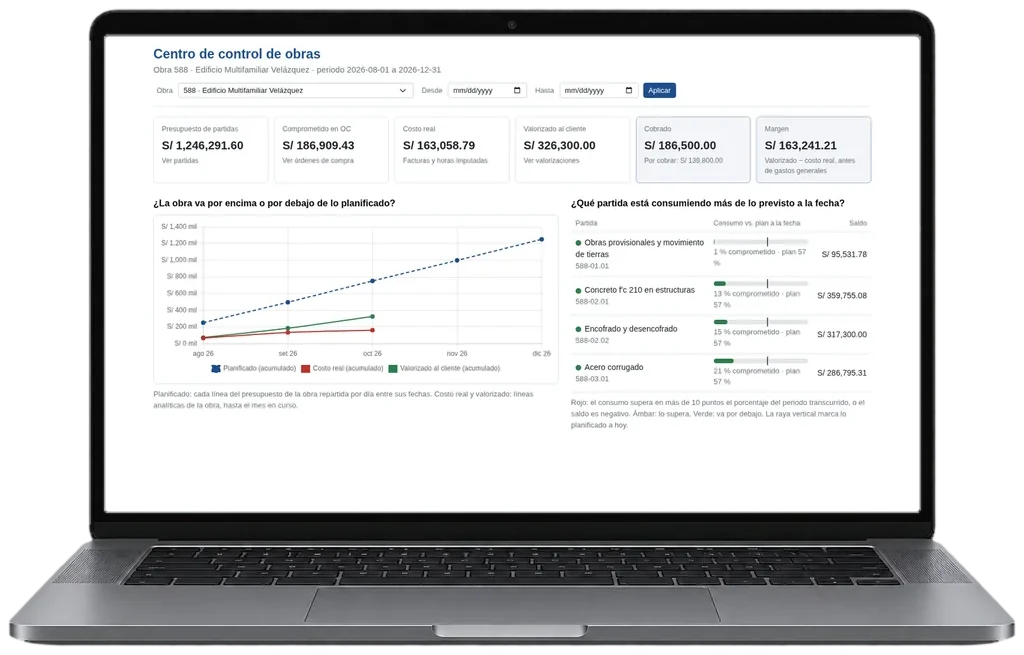
Materials, capacity and cost in one plan
Manufacturing resource planning (MRP II) extends MRP: besides materials, it compares each work centre’s load with its capacity and projects production cost for the period.
Its starting point is a master production schedule that sales, the plant and finance approve together.
Processes it covers
- Master production schedule
- Capacity planning
- Standard costing
- Labour planning

Companies that need an MRP II, and cases where another option fits better
Who it is for
- Plants with several work centres shared across products, where capacity decides the date
- Management teams that build the master schedule with sales and finance every month
- Companies on standard costing that need variance by work centre
When it is not the right fit
- If you do not yet have reliable bills of materials: MRP comes first
- If a single machine limits the whole plant, an APS on that resource pays off before a full master schedule
Signs it is time to assess an MRP II
- The production plan ignores the real capacity of each machine or line
- Overtime is decided on the day because there is no planned load per work centre
- Finance cannot project next month’s production cost
- There is no master plan, or it is a sheet only one person updates
- Sales promises dates without checking plant load
- Bottlenecks shift with the order mix and are not measured
The cost of planning without capacity
Unplanned overtime
Overload is discovered on the day and paid for with overtime or improvised shifts.
Missed dates
Sales promises lead times the plant cannot meet and the customer finds out late.
A budget without a basis
Finance projects production cost from past averages, without the actual plan.
From the master schedule to capacity you can promise
Online assessment
36 questions on plant capacity planning. When you finish you see your level by dimension.
30-minute review
Diego reviews with you how the master schedule is approved today and whether load per work centre is compared with available capacity.
Master planning workshop
With sales, the plant and finance we review how the plan is built, which standard times exist and where the bottleneck is.
Tool selection
We compare 2 to 4 options against your criteria, from Odoo Manufacturing with capacity to industrial suites, with three-year total cost.

Data, master records and access your company provides for an MRP II
- Master schedule for recent months, planned and produced
- Work centres with shifts, efficiency and scheduled downtime
- Standard times per operation and their source
- Current standard costs and finance’s calculation method
Deliverables of the MRP II analysis, selection and integration
Master scheduling process
Approval calendar for the plan between sales, the plant and finance, with a frozen horizon and change rules.
Master scheduling procedure
Capacity model
Rough-cut capacity per work centre and the rule for turning load into overtime or subcontracting.
Validated capacity sheet
Selection matrix
Odoo Manufacturing and other platforms compared on a real plan from your plant and three-year cost.
Signed recommendation
Costing integration
Flow of standard costs, actual consumption and hours to accounting, with variance per work centre.
Costing map
Typical risks of a MRP II project and how they are controlled
A master schedule nobody freezes
ControlA frozen horizon and who may change it are agreed before choosing a tool.
Catalogue standard times
ControlThey are checked against times recorded on the floor before calculating capacity.
Standard cost disconnected from accounting
ControlFinance approves the calculation method and the account for each variance.
Scope limits and market options for MRP II
Limits
- We do not configure or run the chosen platform; the vendor or its integrator does
- Rough-cut capacity planning does not replace fine sequencing per machine
- If the decision is Odoo, we implement it ourselves within the scope of the MRP page
Selection criteria
- Finite or infinite capacity per work centre
- Master plan with versions and approval
- Standard costing compared with actual
- Integration with your ERP and shop-floor recording
Odoo
Odoo Manufacturing with work centres and capacity planning. We assess it as one more option, with the same criteria as the rest.
Other platforms on the market
- SAP S/4HANA
- Oracle E-Business Suite / Fusion SCM
- Microsoft Dynamics 365 Supply Chain
- Epicor Kinetic
- Infor LN
In no order of preference.
Production cost for SUNAT
- Cost register (PLE format 10) with production cost by element when the company must keep it
- Permanent valued inventory consistent with standard cost and its variances
Systems that exchange data with an MRP II
Material requirements planning
material calculation for the plan
See the systemAPSAdvanced planning and scheduling
detailed sequence by machine
See the systemERPEnterprise resource planning
costs, purchasing and sales
See the systemS&OPDemand planning and S&OP
agreed demand plan
See the systemMESManufacturing execution system
actual shop-floor progress
See the systemBI/DWBusiness intelligence and data warehouse
load and cost for dashboards
See the systemMRP II assessment in 9 minutes
This assessment measures how your plant plans production against machine and staff capacity, and how that reaches dates and cost. The questions describe observable situations, such as when an overload is detected or what data sales uses to promise a delivery.
Scored dimensions
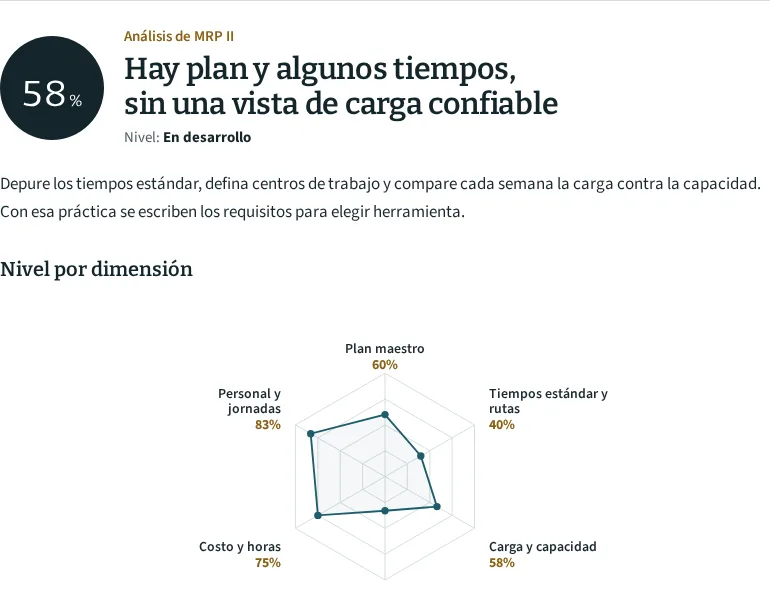
- Master production schedule. Looks at whether there is a master schedule per product and week, with an owner, a frozen horizon and a monthly comparison against output and sales.
- Routings and standard times. Looks at whether each product has its routing by work center and measured, up-to-date setup and run standard times.
- Load versus capacity. Looks at whether planning compares each work center's load with its available capacity per period, with a shift and maintenance calendar.
- Date promising and delivery performance. Looks at what information sales uses to promise dates, when delays become known and who decides which order is postponed.
- Projected cost and overtime. Looks at whether finance projects cost from the plan, whether overtime is measured by cause, and time lost in setups and waiting.
- Operators, skills and shifts. Looks at whether staff capacity is planned with a skills matrix per machine and shift calendars validated with human resources.
What you receive
When you finish you receive your level in six capacity planning dimensions and the gaps ranked by priority. Each gap comes with a first action planning can verify.
19 scored questions and 12 context questions (type of operation, size, current system). Context questions are not scored: they let us read the result against similar operations.
36 questions, 9 minutes
Example: if routings have no times per operation, the result flags Standard times and routings and proposes measuring the limiting work centre first.
Answers about MRP II
MRP II checks whether capacity is enough for the period; an APS sequences orders by machine and shift. The assessment shows which one your plant needs first.
If they do not exist, the first job is to measure them on the highest-volume products. Without them no tool can calculate load.
If the matrix picks Odoo Manufacturing, we implement it. If it picks another platform, its vendor implements it and we design its link with costing and review its tests.
Review your MRP II result with Diego
Twenty minutes by video call or WhatsApp. Have at hand the latest master schedule and the list of work centres.
Assessment first: the review uses your answers.