A machine sequence that survives the rush order
An APS schedules orders by machine and shift with finite capacity, changeovers and materials. We analyse how your plant schedules today and help you choose.
35 questions: sequencing rules, times and changeover matrix and 4 more topics

Detailed scheduling with real constraints
Advanced planning and scheduling (APS) decides the order in which jobs run on each machine, respecting capacity, changeovers, materials and staff.
It also simulates scenarios: which orders slip if a rush order comes in, before accepting it.
Processes it covers
- Detailed scheduling
- Machine sequencing
- Changeovers
- Scenario simulation

Companies that need an APS, and cases where another option fits better
Who it is for
- Plants with a bottleneck resource and format, colour or mould changeovers that cost hours
- Production schedulers who redo the sequence by hand whenever a rush order arrives
- Sales teams who need to promise a date calculated from the real load
When it is not the right fit
- If bills of materials and routings are not in a system: the APS calculates on that data and would fail
- If the plant has spare capacity all year, MRP planning is enough
Signs it is time to assess an APS
- Format or colour changeovers eat hours that could be grouped
- A rush order forces every machine to be rescheduled by hand
- Scheduling depends on one person and their absence stops the plant
- Unneeded batches are made to use an idle machine
- There is no way to simulate what happens if a large order is accepted
- The MRP suggests orders the plant cannot sequence
The cost of scheduling on a whiteboard
Hours lost to changeovers
Without grouping by family or colour, every shift loses machine hours to avoidable changeovers.
Manual rescheduling
Every rush order means redoing the whole sequence, and the effect on other orders shows up late.
Dependence on one person
If the scheduler is away, the plant runs with no sequence or with yesterday’s.
From the bottleneck to a sequence the floor actually follows
Online assessment
35 questions on production scheduling. When you finish you see your level by dimension.
30-minute review
Diego reviews with you which resource limits the plant and how much time changeovers take with the current sequence.
Bottleneck workshop
With the plant we measure cycle and changeover times and write down the sequencing rules and mandatory constraints.
Tool selection
We compare 2 to 4 APS tools against your real constraints, a trial with your orders and three-year total cost.

Data, master records and access your company provides for an APS
- Routings with processing times by product and machine
- Changeover time matrix between products on the limiting resource
- Shift calendar, scheduled maintenance and staffing constraints
- Open orders with committed date and commercial priority
- Read access to the ERP for orders, stock and incoming purchases
Deliverables of the APS analysis, selection and integration
Constraint model
Resources, shifts, changeover matrix and priority rules written down and validated with the scheduler.
Model signed off by the plant
Test on your real week
Each candidate platform sequences the same week of orders and changeover hours and delays are compared.
Sequence comparison
ERP integration
Orders and stock the APS reads from the ERP, and start and end dates it writes back to each manufacturing order.
Interface specification
Rescheduling rule
Which events trigger a new sequence, who approves it and which horizon stays frozen.
Scheduling procedure
Typical risks of a APS project and how they are controlled
Changeover matrix estimated from memory
ControlIt is measured on the floor for two or three weeks before the platform test.
A sequence the plant does not follow
ControlThe scheduler takes part in the model and the published sequence is compared with what was run.
Rescheduling on every phone call
ControlA frozen horizon and a written rule for which order goes first.
Scope limits and market options for APS
Limits
- We do not configure or run the chosen APS; the vendor or its integrator does
- An APS does not fix wrong bills of materials or routings: it uses them as they are
- The promised date depends on the plant recording each order’s actual progress
Selection criteria
- Modelling of your constraints: changeovers, materials and staff
- Speed of rescheduling and scenario simulation
- Feedback of actual shop-floor progress
- Integration with your ERP or MRP
Other platforms on the market
- SAP IBP / PP-DS
- Siemens Opcenter APS (Preactor)
- DELMIA Ortems
- Asprova
- PlanetTogether
- Kinaxis Maestro
In no order of preference.
Systems that exchange data with an APS
Material requirements planning
orders and available materials
See the systemMRP IIManufacturing resource planning
capacity and master plan
See the systemMESManufacturing execution system
published schedule and actual progress
See the systemERPEnterprise resource planning
orders and committed dates
See the systemS&OPDemand planning and S&OP
demand scenarios
See the systemAPS assessment in 9 minutes
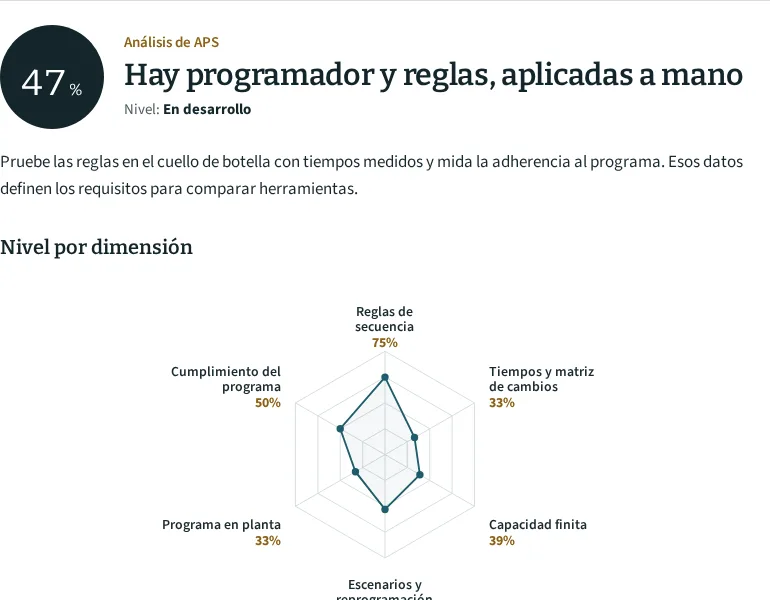
This assessment measures how your plant sequences production orders by machine and shift. The questions cover sequencing rules, changeover times, bottleneck, rescheduling and shop floor feedback.
Scored dimensions
- Sequencing rules. Whether the order of jobs on each machine follows written rules by family, color or date, applied the same way by any scheduler.
- Cycle times and changeover matrix. How close to reality the cycle times by product and machine, and the format-to-format changeover times used by the schedule, are.
- Bottleneck and finite capacity. Whether the schedule recognizes the plant's constraining resource, respects its real capacity and releases only jobs with material available.
- Simulation and rescheduling. How a rush order, a machine stop or a large order is evaluated before changing the current schedule, and who approves the change.
- Schedule dispatch to the floor. How the sequence reaches each machine, how long it stays unchanged and how actual progress of each job comes back.
- Sequence adherence. Whether the share of the schedule executed in the planned sequence and date is measured, with the cause of each deviation.
What you receive
At the end you receive your level in each plant scheduling dimension. Each gap comes with the first action you can verify in your plant.
19 scored questions and 11 context questions (type of operation, size, current system). Context questions are not scored: they let us read the result against similar operations.
35 questions, 9 minutes
Example: if changeover times between products are not measured, the result flags Times and changeover matrix and proposes building the bottleneck’s matrix.
Answers about APS
When there are many orders a week, sequencing constraints and frequent priority changes. With few orders a good spreadsheet may be enough; the assessment shows which.
Measured cycle and changeover times, written sequencing rules and actual shop-floor progress. Without them the schedule is not met.
The APS is configured by its vendor. We write the constraint model, run the test on your real week and design the exchange of orders and dates with your ERP.
Review your APS result with Diego
Twenty minutes by video call or WhatsApp. Have at hand one week’s sequence for your busiest machine.
Assessment first: the review uses your answers.